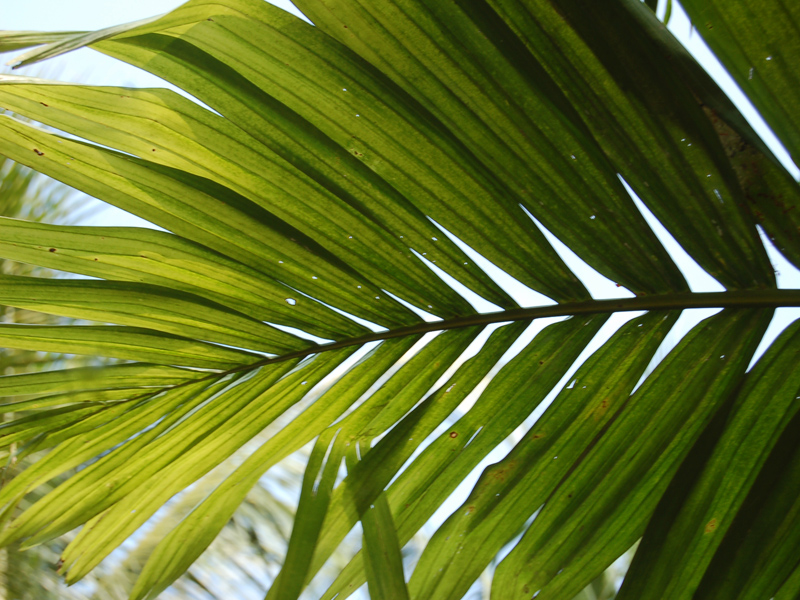
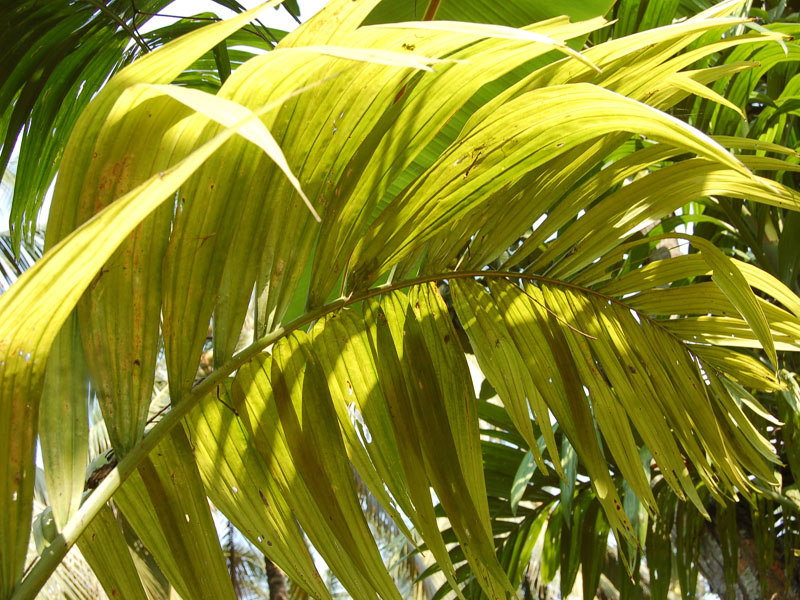
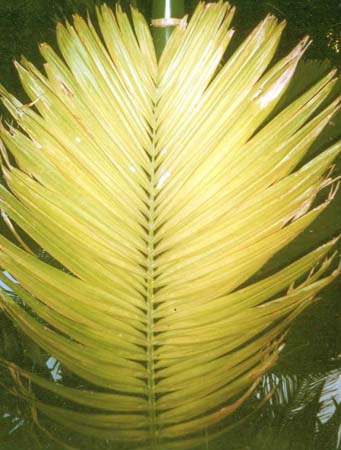
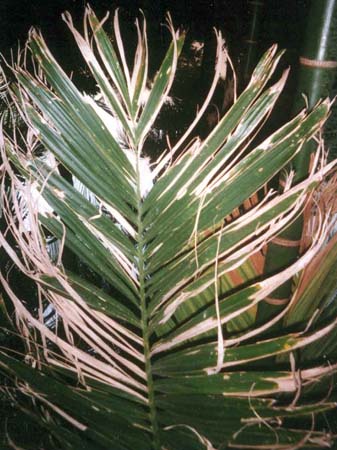
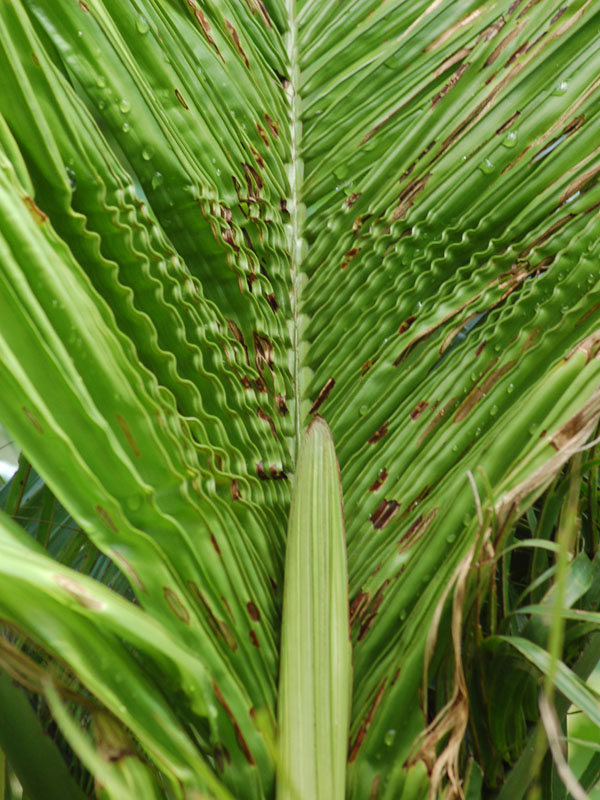
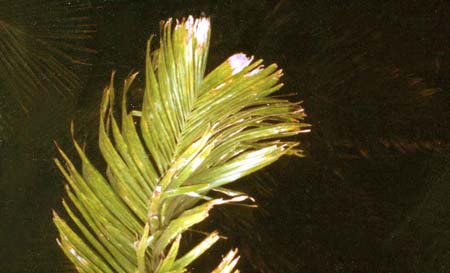
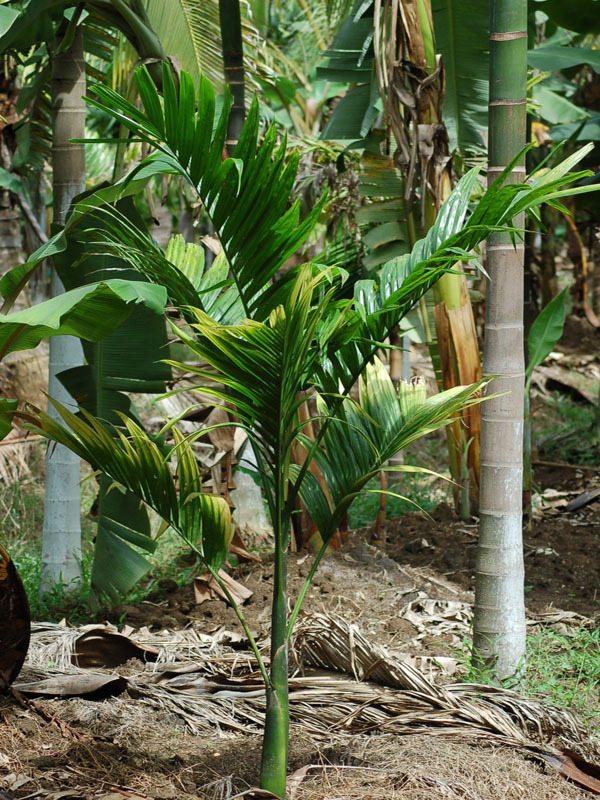
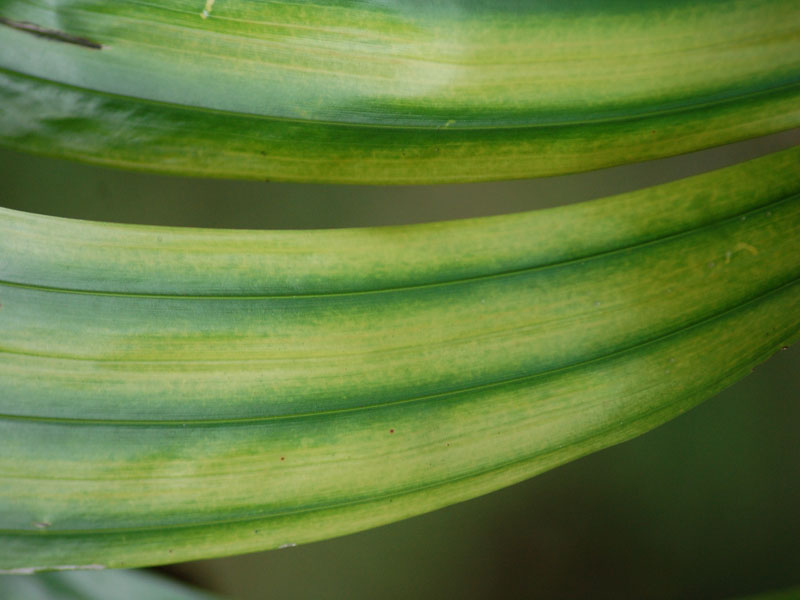
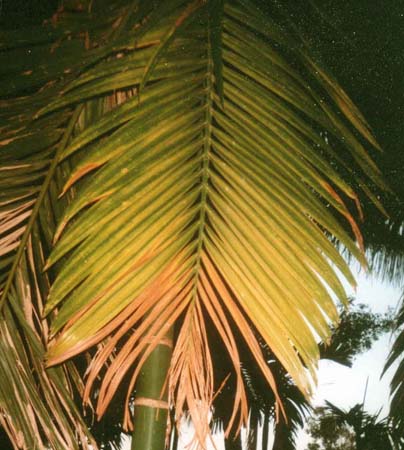
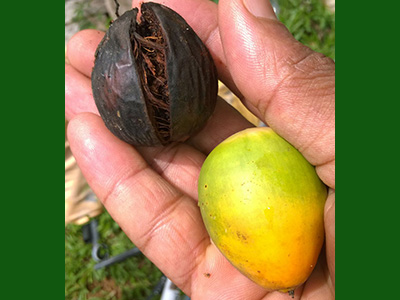
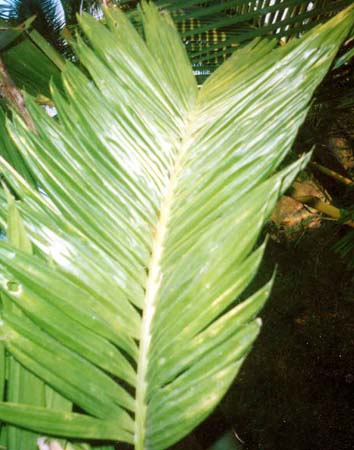
Deficiency symptoms will be first seen in older and lower leaves
Yellowing starts from the base of leaf tip of older leaves
Plant exhibit Stunted growth where shoot elongation is reduced
Fewer number of leaves are noticed.
Delayed emergence of new leaves
Arecanut plants may have sparse & thin foliage
No of fruit bunches & size of individual fruits are reduced.
Management
For determining the severity of the deficiency, soil analysis has to be done
Application of quick releasing nitrogen fertilizer like urea, according to the results of the soil test.
Frequent application of organic growth boosters is also beneficial.
Apply urea as a foliar spray (10 gram per litre of water) once every 15 days .
Phosphorus (P)
Symptoms
Deficiency seen on older and lower leaves.
Delays flowering & emergence.
Number of Inflorescence & size of individual fruits were diminished.
Leaves appear with shorter petioles, rosetting of the leaves may occur and growth may be restricted.
Old leaves on seedlings may also dry out severely.
Under developed root system & exhibit reduced branching.
Management
Ensure that recommended amount of fertilizer is applied on regular time.
For determining the severity of the deficiency, soil analysis is to be done
Use fertilizers such as single superphosphate for quick correction or bone meal or rock phosphate for long-term correction.
In the pH range of 6.5-7.5, phosphorus is readily absorbed by the roots.
Addition of biofertilizers including phosphorus solubilizing bacteria along with organic manure helps to increase the availability of phosphorus
Potassium (K)
Symptoms
Brown & necrotic patches on Leaf margin.
Brown typically from leaf tips & profusely inwards
Leaf may exhibit Curling, Cupping, distorted in shape.
Reduced Flowering & fruit production.
Exhibit stunted growth.
Management
In the pH range of above 6, Potassium is readily available.
Maintain pH by addition of lime/dolomite
Improve the soil fertility by adding organic matter and wood ash.
For determining the severity of the deficiency, soil analysis is to be done
Use Muriate of Potash (MOP) according to the results of the soil test. Split application is preferable.
Calcium (Ca)
Symptoms
Deficiency is seen mainly in growing points, younger leaves and developing fruits.
Abnormal growth of young leaves and growing points which resembling boron deficiency.
Necrosis & browning of young leaves
Leaf curling ,wrinkling & distortion occur.
Severe deficiency leads to death of the bud.
Poor fruit quality
Nuts may exhibit reduce size, distorted in shape, blackening or decay
Under developed root system with reduced branches
Management
Analysis of pH in the soil
If the soil is acidic, add 0.5-1 kg of lime per palm per year in two split doses.
Dolomite can be substitute of lime
High phosphorus levels leads to calcium deficiency.
In alkaline soil application of Gypsum is preferable
Magnesium (Mg)
Symptoms
Symptoms seen first in the older leaves
Exhibits leaf curling, distorted and have cupped shape.
Inter-venial chlorosis followed by necrosis and affected area begin to brown & eventually die
Nuts may exhibit reduced size & other physiological orders which turn bronzed and dry later on.
Reduced nut production.
Management
Do the soil analysis and confirm the deficiency.
Addition of Magnesium sulphate (60 gram /palm or 32 kg/ acre) in bands near plants.
Long-term usage of dolomite will reduce magnesium deficiency
Magnesium and potassium fertilizers should not be applied together.
Boron (B)
Symptoms
Symptoms seen mainly in growing points, younger leaves and developing fruits.
Growing tip of the plant including terminal bud dies back & necrotic lesions which lead to entire death of plant
Leaves exhibit chlorosis & necrosis starting from margin tips & progresses towards inwards.
Terminal leaflets remain fused
Number & size of the inflorescence is reduced.
Nuts of plant become hollow in centers, may undergo discoloration & reduced market value.
Spear shortens and the leaves are reduced to an embryonic mid-rib without leaflets. This is the so-called ‘little-leaf’ stage.
One of the most frequent signs is nut cracking on the inflorescence followed by shedding.
Management
Analysis of soil to confirm the deficiency.
Application of borax (20 gram /palm or 4 kg/ acre) into the soil
Avoid the combined application of Boron and calcium.
Application of borax with ammonium fertilizers should be avoided
Addition of borax (1 gram / liter of water) as foliar
Copper (Cu)
Symptoms
Chlorosis of newly emerged leaves
Necrosis & die back of affected parts of plants
Number of inflorescences are reduced
Malformed leaves are noticed.
Overall growth of plant is stunted
Management
Apply Copper sulphate (2 gram /plant or 800 gram/ acre) in the soil.
Zinc (Zn)
Symptoms
Leaves may be distorted in leaf blade which become narrow & twisted
Overall size of plant is reduced
Poor yield.
Management
The optimal pH range for zinc availability is 5 to 7.5.
Confirm deficiencies by doing soil testing.
Apply zinc sulphate to deficient soils (110 gm /palm or 8 kg/ acre)
Avoid the application of Zinc and phosphate fertilizers at the same time
In severe cases, foliar spraying of Zinc sulphate (2 gram/liter of water) with Calcium carbonate (2.5 gram/liter of water) can be advocated in morning hours.