

Cashew (Anacardium occidentale)
Inflorescence blight (Colletotricum magiferae)
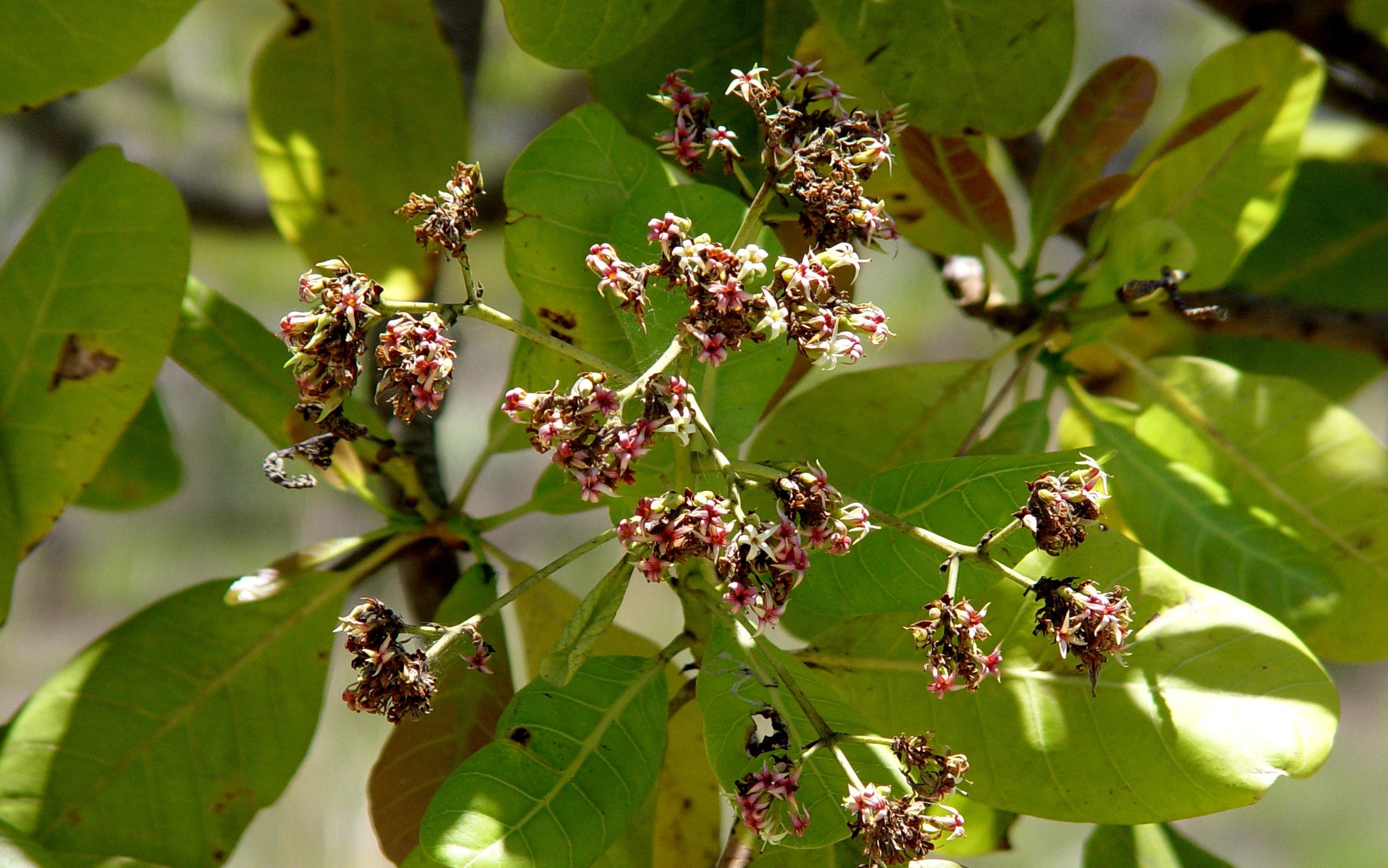
Symptoms
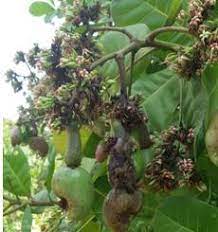
- This common disease is characterized by the drying of floral branches. The symptoms appear as minute water soaked lesions on the main rachis and secondary rachis.
- The lesions are pinkish brown, enlarge and soon turn scabby.
- Gummy exudates can be seen at the affected regions.
- The lesions develop into bigger patches and result in drying up of the inflorescences. The incidence is very severe when cloudy weather prevails.
Management
- It is often caused by the combined infestation and infection of tea mosquito and fungus.
Chemical Control
| Sl.No | Generic Name | Trade Name | Color code | Dosage/litre | Knapsack Sprayer (Capacity 10L) | Recommendation | Remarks | |
|---|---|---|---|---|---|---|---|---|
| Dosage/acre (200 L) | Dosage/hectare (500 L) | |||||||
| 1 | Copper oxychloride 50 WP | Bensaan, Blitox, Blue copper, Bluetrox, Copter, Cupramar, Cuprina, Dhanucop, Fytolan, Fytox, Fytran, Fytolan, Hilcopper, Killex copper, Maincop Dhanucop, Star cop, Tagcop, Trucop | Blue | 2 g | 20 g | 400 g | 1000 g | Combination spray of Copper oxychloride 50 and insecticide Lamda cyhalothrin |
| 2 | Lamda cyhalothrin 5 EC | Agent, Excel Glow Constant, Kabhaddi, Kunfu, Lambda 2.5, Lambda Star Veera, Lancer Lamdex, Marsjudo, Ninja-R, Reeva, Samurai Tag Demand, Santri | Yellow | 0.6 ml | 6 ml | 120 ml | 300 ml | Combination spray of Copper oxychloride 50 and insecticide Lamda cyhalothrin |
Extremely Toxic

Highly Toxic

Moderately Toxic