

Cashew (Anacardium occidentale)
Cashew Stem & Root borer (Plocaederusferrugineus)
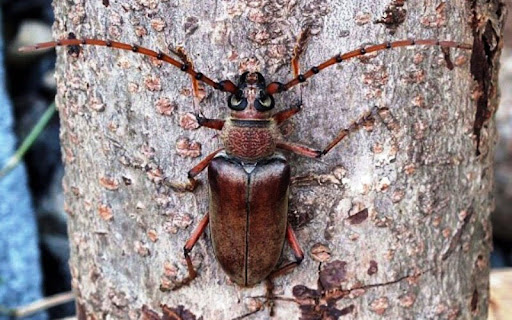
Symptoms
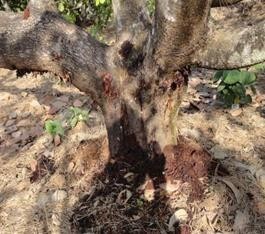
- Occurrence of small borer holes at the collar region,extrusion of coarse dust powder like frass through the holes and discharge of gum at the basal region of the tree.
- Yellowing and shedding of leaves and finally death of the tree.
- Severe injury to the roots also affect stand of the tree which may tilt to one side
Management
- Phytosanitation should be done. Severely affected plants should be uprooted and removed from the plantation.
- In case external infestation symptoms are noticed, the CSRB grubs should be mechanically removed by careful chipping of the bark.
- When cutting in this way, care should be taken not to lose more than 50 percent of the bark.
- To prevent the spread of pest infestation, trees that are infected and likely to die should be removed from the orchard at least once every six months.
- Prophylatic treatment of healthy trees with coal tar-kerosene mixture (1:2) ratio is found effective.
Chemical Control
| Sl.No | Generic Name | Trade Name | Color code | Dosage/litre | Knapsack Sprayer (Capacity 10L) | Recommendation | Remarks | |
|---|---|---|---|---|---|---|---|---|
| Dosage/acre (200 L) | Dosage/hectare (500 L) | |||||||
| 1 | Chlorpyrifos 20 EC | Chlorban, Classic-20 Coroban, Dhanvan, Durmet, Dursban, Hilban, Krishan, Radar Starban, Tafaban, Tagban, Tricel. | Yellow | 10 ml | 100 ml | 2000 ml | 5000 ml | Swab the chiseled area with Chlorpyrifos 20 EC and drench Chlorpyriphos 20 EC (2 ml/litre of water) solution into the soil near the root zone to minimize reinfestation by the pest. |
Extremely Toxic

Highly Toxic

Moderately Toxic