
Mango (Mangifera indica)
Die Back (Botryodiplodia (Lasiodiplodia) theobromae)
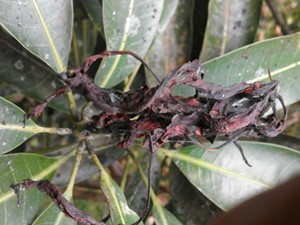
Symptoms
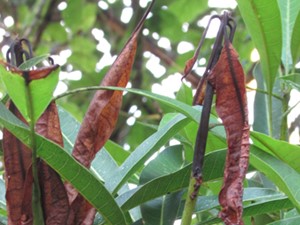
- The disease on the tree may be noticed at any time of the year but it is most conspicuous during October-November.
- The disease is characterized by drying of twigs and branches followed by complete defoliation, which gives the tree an appearance of scorching by fire.
- The affected leaf turns brown and its margins roll upwards.
- At this stage, the twig or branch dies, leaves shrivel and fall off.
- This may be accompanied by exudation of yellowish-brown gum from the infected twigs and branches.
Management
- Prune the diseased twigs 2-3 inches below the affected portion.
- Paste the pruned twigs with Bordeaux paste or Copper oxychloride 50 WP (10 g/litre of water) followed by spraying of Bordeaux mixture 1%.
Chemical Control
| Sl.No | Generic Name | Trade Name | Color code | Dosage/litre | Knapsack Sprayer (Capacity 10L) | Recommendation | Remarks | |
|---|---|---|---|---|---|---|---|---|
| Per acre (200 L) | Per hectare (500 L) | |||||||
| 1 | Copper Oxychloride 50 WP | Bensaan, Blitox, Blue copper, Bluetrox, Copter, Cupramar, Cuprina, Dhanucop, Fytolan, Fytox, Fytran, Fytolan, Hilcopper, Killex copper, Maincop Dhanucop, Star cop, Tagcop, Trucop | Blue | 2-3 gram/1 litre of water | 20-30 g | 400 – 600 g | 1-1.5 kg | Paste the pruned twigs with spraying on infected tree |
Extremely Toxic

Highly Toxic

Moderately Toxic