

Rose (Rosa rubiginosa)
Blossom blight (Botrytis cinerea)
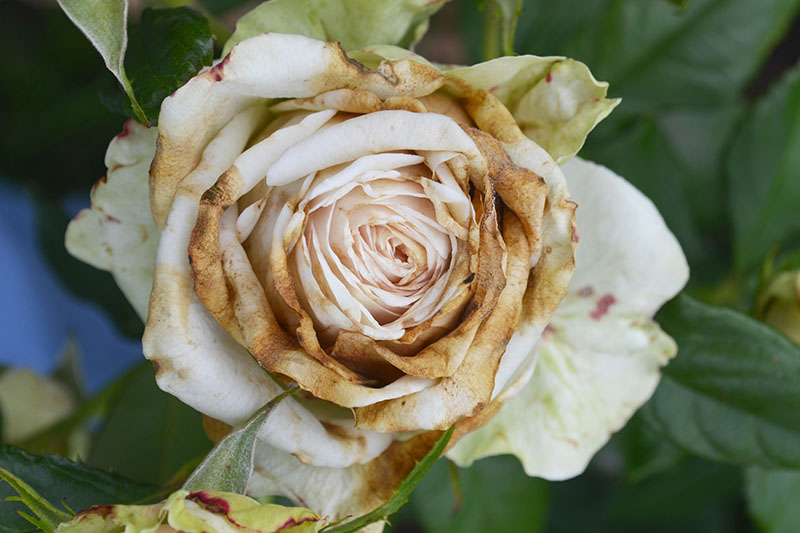
Symptoms
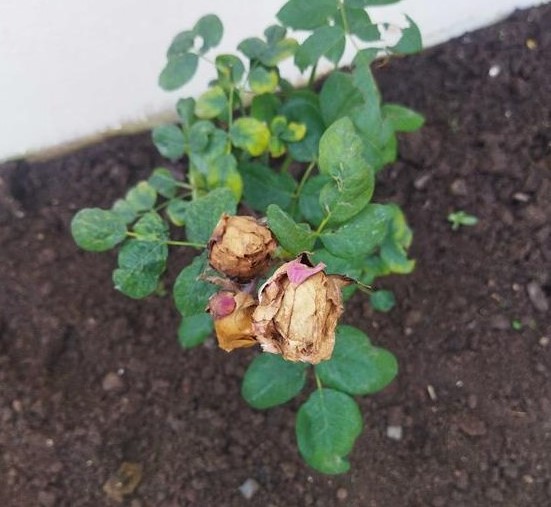
- Infected buds usually fail to open and become covered with grey to grayishbrown growth of the fungus. Infection of open flowers also occurs.
- Small, more or less circular, lesions form on petals that may develop into blotches and rot the flowers.
- The disease causes flower buds to droop and remain closed.
- Buds turn brown and decay.
- Sometimes partially opened buds are attacked and an entire flower may be covered by gray fungus.
Management
- Practice crop sanitation.
- Destroy dead and diseased plant parts
- Avoid moisture condensationin the polyhouse.
- Adjust temperature to 21°C and relative humidity below 85 % in the greenhouse area
- Sprays plants with mancozeb (0.2%) or chlorothlanil (0.2%) at suitable intervals. Sprays
- of the fungicides vinclozolin (0.2%) or iprodione (0.2%) are also very effective.
Chemical Control
| Sl.No | Generic Name | Trade Name | Color code | Dosage/litre | Knapsack Sprayer (Capacity 10L) | Recommendation | Remarks | |
|---|---|---|---|---|---|---|---|---|
| Dosage/acre (200 L) | Dosage/hectare (500 L) | |||||||
| 1 | Carbendazim 50 WP | Bavistin, Benfil, Bengard, Benlate, Benmain, Bensaan, Carben, Carziim50, Dhanustin, Dhanustin 50 WP, Fungiguard, Gancarzin50, Glizim, Mintho, Tagstin, Tiara, Zoom | Green | 1g/ litre of water | 10 g | 200 g | 500 g | |
| 2 | Mancozeb 75 WP | Devidayal M-45, Dhanuka M 45, Dhanuka M-45, Dithane, Dithane M-45, Hilthane, Hindustan M 45, Indofil M 45, Izeb M-45 Manzate, Luzen-45, Macoban, Macoban M-45, Mancosaan, Mancosaan M-45, Maneb Manzane, M-Guard, Savour M 45, Tata M-45 Eurofil-NT, Uthane M-45, Veera, Zinthane | Green | 3 g/ litre of water | 30 g | 600 g | 1500 g | |
Extremely Toxic

Highly Toxic

Moderately Toxic