

Cardamom (Elettaria cardamomum)
Azhukal (Phytophthora nicotianae var. nicotianae, P. meadii)
Symptoms
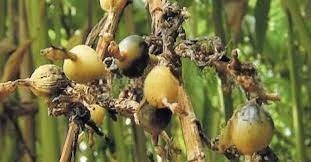
- It affects the leaves, tender shoots, panicles and capsules.
- On the infected leaves, water soaked lesions appear first and rotting and shedding of leaves along the veins occur thereafter.
- The infected capsules become dull greenish brown and decay.
- This emits a foul smell and subsequently shed.
- Infection spreads to the panicles also.
Management
- Trashing and destruction of the infected parts should be done as a phytosanitary measure just prior to the onset of southwest monsoon.
- Spray the shoots with 1 per cent Bordeaux mixture with adhesive (rosin soda or any other sticker) by the commencement of the monsoon and continue the spraying operation two or three times up to November – December
- Prophylactic application of the biocontrol agent Pseudomonas fluorescens (two percent spray) along with basal application of Mycorrhiza (100 g) and Trichoderma viride (50 g) per plant by the commencement of the monsoon and continue the spraying operation monthly depending on the intensity of the disease and rainfall.
- Trichoderma can be used along with cowdung for controlling this disease.
- Give spray to the panicle with 1 per cent Bordeaux mixture during July-August when the disease intensity is maximum.
Chemical Control
| Sl.No | Generic Name | Trade Name | Color code | Dosage/litre | Recommendation | Remarks | |
|---|---|---|---|---|---|---|---|
| Dosage/acre (200 L) | Dosage/hectare (500 L) | ||||||
| 1 | Potassium phosphonate 40 SC | Akomin | Green | 4 ml/litre of water | 800 ml | 2000 ml | Drench and spray during initial stage of infection |
| 2 | Fosetyl-Al 80 WP | Aliette | Green | 2 gm/L | 400 ml | 1000 ml | Both spraying and soil drenching in diseased gardens |
Extremely Toxic

Highly Toxic

Moderately Toxic