Amorphophallus (Amorphophallus paeoniifolius)
Collar rot or Foot rot (Sclerotium rolfsii)
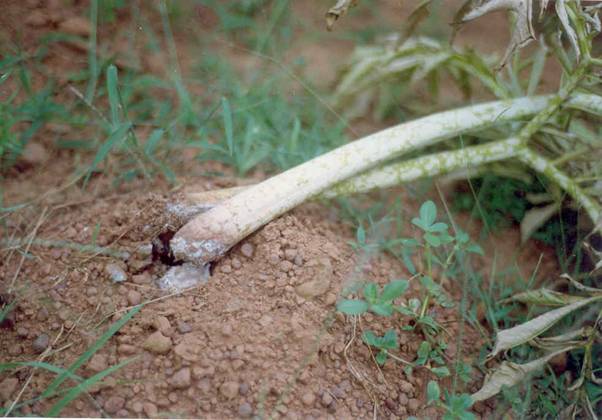
Symptoms
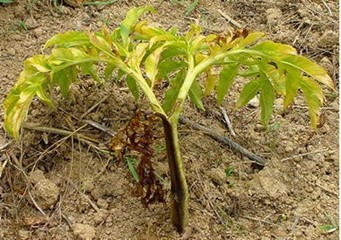
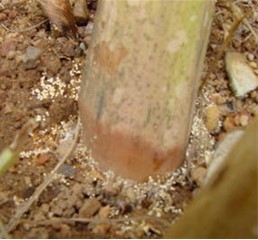
- The disease initially manifests as water-soaked brownish lesions in the collar region of the plant, leading to decay.
- Subsequently, it spreads throughout the entire pseudostem, resulting in complete yellowing.
- The base of the stem shrinks, rots, and collapses, potentially causing severe crop loss if the plant collapses.
- Factors such as waterlogging, poor drainage, and mechanical injury at the collar region promote the incidence of the disease.
Management
- Select tubers from healthy plants.
- Dip the planting materials in Trichoderma – Cowdung Slurry (5 g Trichoderma / kg cowdung).
- Soil application of Trichoderma enriched cow dung (1 kg/pit).
Chemical Control
| Sl.No | Generic Name | Trade Name | Color code | Dosage/litre | Knapsack Sprayer (Capacity 10L) | Recommendation | Remarks | |
|---|---|---|---|---|---|---|---|---|
| Dosage/acre (200 L) | Dosage/hectare (500 L) | |||||||
| 1 | Carbendazim 50 WP | Bavistin, Benfil, Bengard, Benlate, Benmain, Bensaan, Carben, Carziim50, Dhanustin, Dhanustin 50 WP, Fungiguard, Gancarzin50, Glizim, Mintho, Tagstin, Tiara, Zoom | Green | 2 g | 20 g | 400-600 g | 1000-1500 g | Drench the soil |
Extremely Toxic

Highly Toxic

Moderately Toxic