
Cabbage (Brassica oleracea var. capitata)
Diamond back moth (Plutella xylostella)
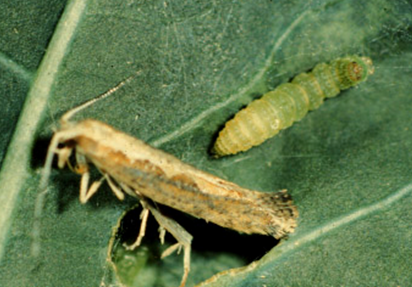
Symptoms
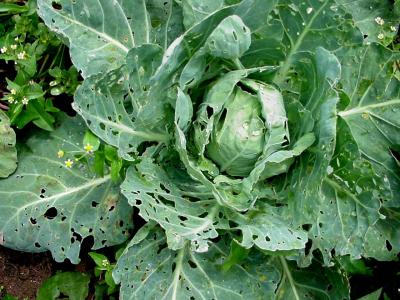
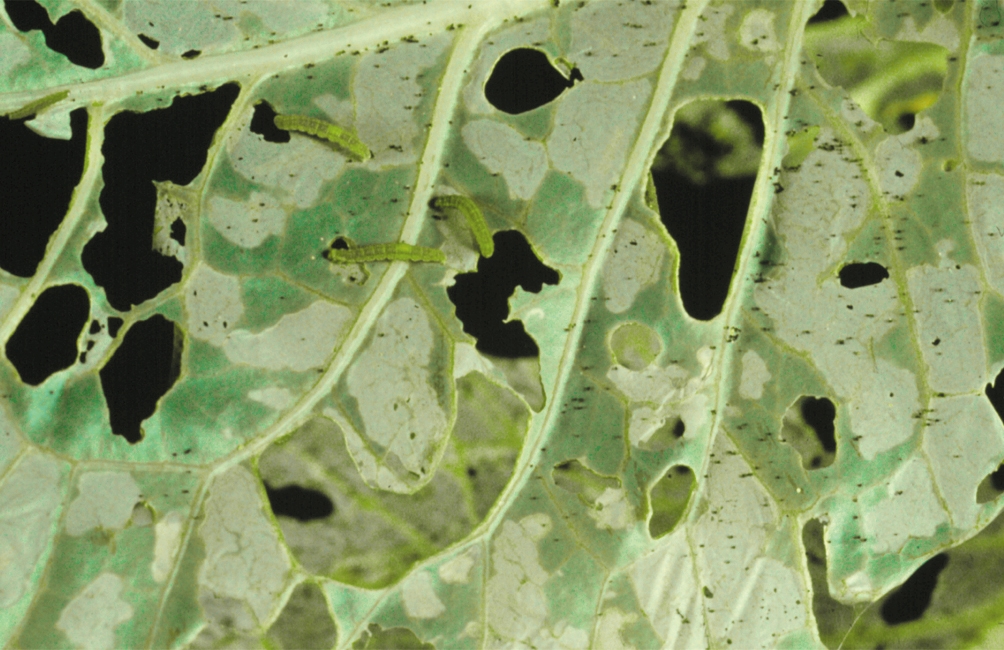
- The young larvae mine epidermal surface of leaves producing typical white patches.
- Later onwards, they feed externally making holes on the leaves and discolour with excreta.
- Heavy infestations result in complete defoliation with only leaf veins remains.
- Severely affected leaves are completely skeletonized.
- The infestation is more in comparatively high temperature conditions.
Management
- Grow mustard as trap crop.
- Install light traps.
- Install pheromone trap to monitor DBM adults@ 5/ha and 25/ha for mass trapping.
- Removal and destruction of plant debris after harvest and ploughing
- Intercropping with tomato or carrot reduces the incidence.
- Spray neem seed kernel extract 5%.
- Apply Bacillus thuringiensis formulation (1 gram/litre of water) or Neem Seed Kernal Extract (40 gram/litre of water) spray.
- Conserve larval parasitoids viz., Cotesia plutellae in plains and Diadegma semiclausam in hills. Release 40,000 adults/ ac, five times@ 8,000 adults/release commencing from 20 days after planting.
- Also encourage other parasitoids like Apanteles sicarius, Tetrastychus sokolowski (larval) Diadrumus collaris (larval pupal) and Brachymeria excarinata (pupal parasitoids).
Chemical Control
| Sl.No | Generic Name | Trade Name | Color code | Dosage/litre | Knapsack Sprayer (Capacity 10L) | Recommendation | Remarks | |
|---|---|---|---|---|---|---|---|---|
| Dosage/acre (200 L) | Dosage/hectare (500 L) | |||||||
| 1 | Cyantraniliprole 10.26% OD | Benevia | Green | 2 ml/litre of water | 20 ml | 400 ml | 1000 ml | - |
| 2 | Chlorantraniliprole 18.5 SC | Coragen | Green | 0.1 ml/litre of water | 1 ml | 20 ml | 50 ml | - |
| 3 | Indoxacarb 15.8 EC | Avaunt, Dhawa Gold, Fego, PI Indox | Yellow | 0.5 ml/1 litre | 5 ml | 100 ml | 250 ml | - |
| 4 | Flubendiamide 20 WG | Fluton, Takumi | Green | 0.1 g/litre of water | 1 g | 20 g | 50 g | - |
| 5 | Emamectin benzoate 5 SG | EM-1, Prabhaav, Proclaim, Robot Starclaim, Spolit | Yellow | 0.4 g/litre of water | 4 g | 80 g | 200 g | - |
Extremely Toxic

Highly Toxic

Moderately Toxic