

Cabbage (Brassica oleracea var. capitata)
Sclerotinia rot/ White Mould (Sclerotinia sclerotiorum)
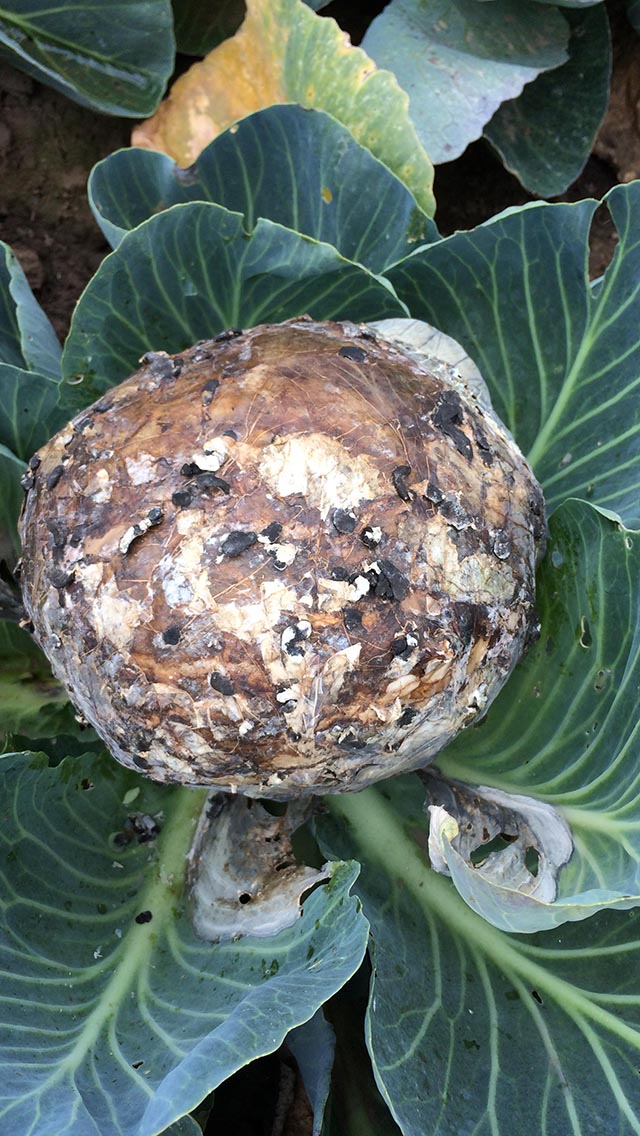
Symptoms
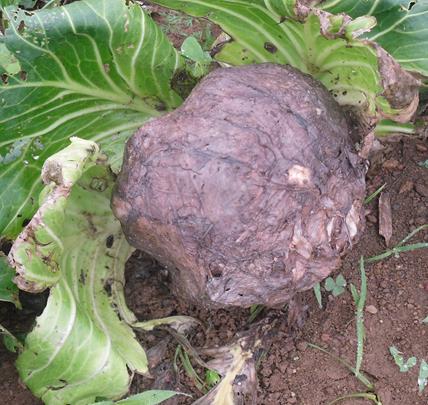
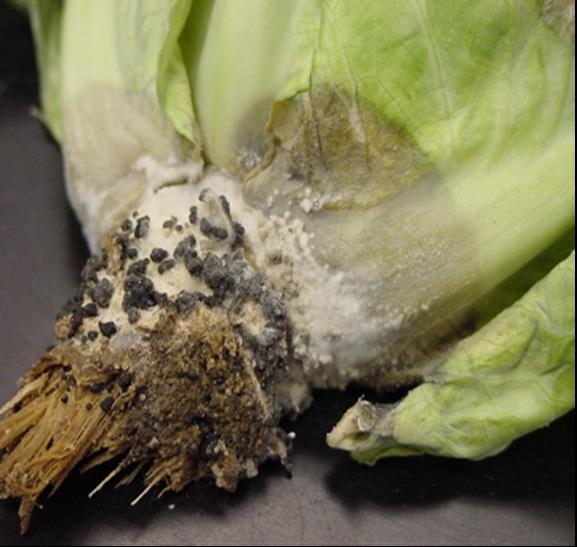
- Infections may occur on the stem at the ground level, on the leaves at their bases, or where the foliage comes in contact with the soil.
- The infected leaves lose their turgor during day time and droop down to the ground, but regain turgidity during night or early morning.
- The yellowing starts from tips of the older leaves downwards which shed, prematurely.
- The infections begin as water-soaked, circular areas, which soon become covered by white, cottony fungal growth.
- The affected tissue becomes soft and watery as the disease progresses.
- The fungus eventually colonizes the entire cabbage head and produces large, black, seed like structures called sclerotia on the diseased tissue.
Management
- Rows should be planted in the direction of the prevailing winds to promote free flow of air movement within the plants.
- Fields with a history of white mold should be planted with non-susceptible crops such as grains (corn, rye, wheat, etc.).
- Cabbage and other susceptible crops (cauliflower, beans, peas, etc.) should not be planted in fields where white mold has become a problem because continuous cropping of susceptible crops will result in a buildup of the fungus in the soil and increased disease incidence.
- Mechanical injuries to cabbage heads during harvesting operations should be avoided.
- Remove infected leaves at weekly intervals.
- Soil amendment with oil cakes like sunflower and mustard and mulching with pine needles and sunflower inflorescence also reduces the disease incidence.
- Some antagonistic fungi like Trichoderma harzianum, T. viride, Gliocladium virens and Coniothyrium minitans have been found promising in managing this disease.
- These fungi either inhibit the development of new sclerotia or destroy the developed ones by colonizing them.
Chemical Control
| Sl.No | Generic Name | Trade Name | Color code | Dosage/litre | Knapsack Sprayer (Capacity 10L) | Recommendation | Remarks | |
|---|---|---|---|---|---|---|---|---|
| Dosage/acre (200 L) | Dosage/hectare (500 L) | |||||||
| 1 | Carbendazim 50 WP | Bavistin, Benfil, Bengard, Benlate, Benmain, Bensaan, Carben, Carziim50, Dhanustin, Dhanustin 50 WP, Fungiguard, Gancarzin50, Glizim, Mintho, Tagstin, Tiara, Zoom | Green | 1 g/litre of water | 10 g | 200 g | 500 g | - |
| 2 | Mancozeb 75 WP | Devidayal M-45, Dhanuka M 45, Dhanuka M-45, Dithane, Dithane M-45, Hilthane, Hindustan M 45, Indofil M 45, Izeb M-45 Manzate, Luzen-45, Macoban, Macoban M-45, Mancosaan, Mancosaan M-45, Maneb Manzane, M-Guard, Savour M 45, Tata M-45 Eurofil-NT, Uthane M-45, Veera, Zinthane | Green | 3 g/litre of water | 30 g | 600 g | 1500 g | - |
Extremely Toxic

Highly Toxic

Moderately Toxic