

Carrot (Daucus carota)
Bacterial soft rot (Erwinia carotovora p.v. carotovora and Erwinia carotovora p.v. atroseptica)
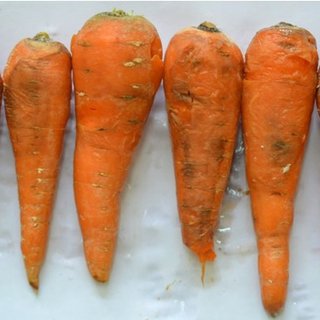
Symptoms
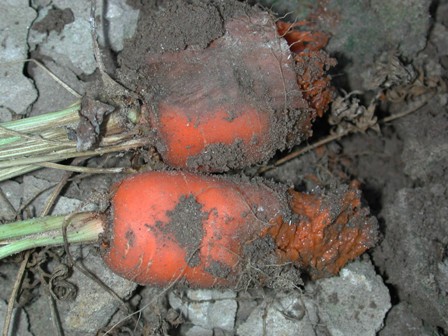
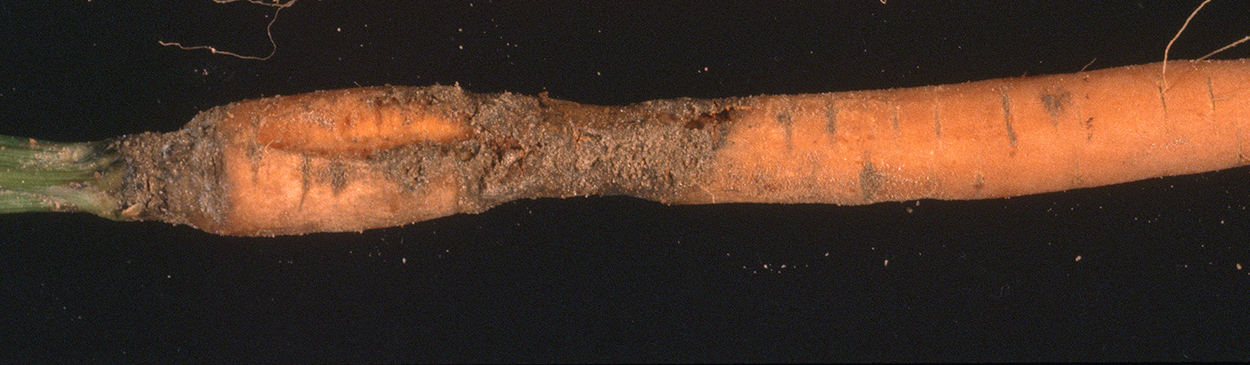
- Bacterial soft rots of carrots occur only when soil conditions are wet or storage conditions are poor.
- Soft water-soaked and irregular lesions appear on the roots.
- Initially these lesions are superficial but soon spread to cover the inner tissues.
- The foliage may remain green until the disease on the tuber advances considerably.
- The entire plant wilts when complete rotting of the tuber takes place.
- Rotted tissues are grey to brown in colour, accompanied by foul odour.
- Abundant moisture on the root surface favours disease incidence.
Management
- Plant carrot in raised beds in poorly drained areas.
- Crop rotation with alfalfa, beans, beets, corn .etc.
- Careful harvesting, handling, grading and sanitation are the only ways to reduce the problem.
- The diseased roots should not be stored along with the healthy tubers.
- The root surface should be kept dry and stored at OoC with 95 % relative humidity.
Chemical Control
| Sl.No | Generic Name | Trade Name | Color code | Dosage/litre | Knapsack Sprayer (Capacity 10L) | Recommendation | Remarks | |
|---|---|---|---|---|---|---|---|---|
| Dosage/acre (200 L) | Dosage/hectare (500 L) | |||||||
| 1 | Copper oxychloride 50 WP | Bensaan, Blitox, Blue copper, Bluetrox, Copter, Cupramar, Cuprina, Dhanucop, Fytolan, Fytox, Fytran, Hilcopper, Killex copper, Maincop, Star cop, Tagcop, Trucop | Blue | 2 g/litre of water | 20 g | 400 g | 1000 g | - |
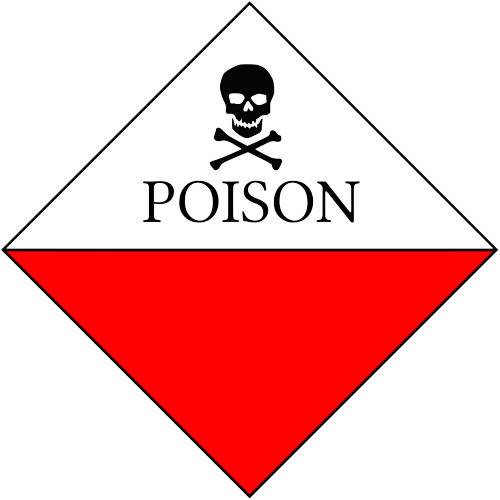
Extremely Toxic

Highly Toxic

Moderately Toxic