

Potato (Solanum tuberosum)
Late Blight(Phytophthora infestans)
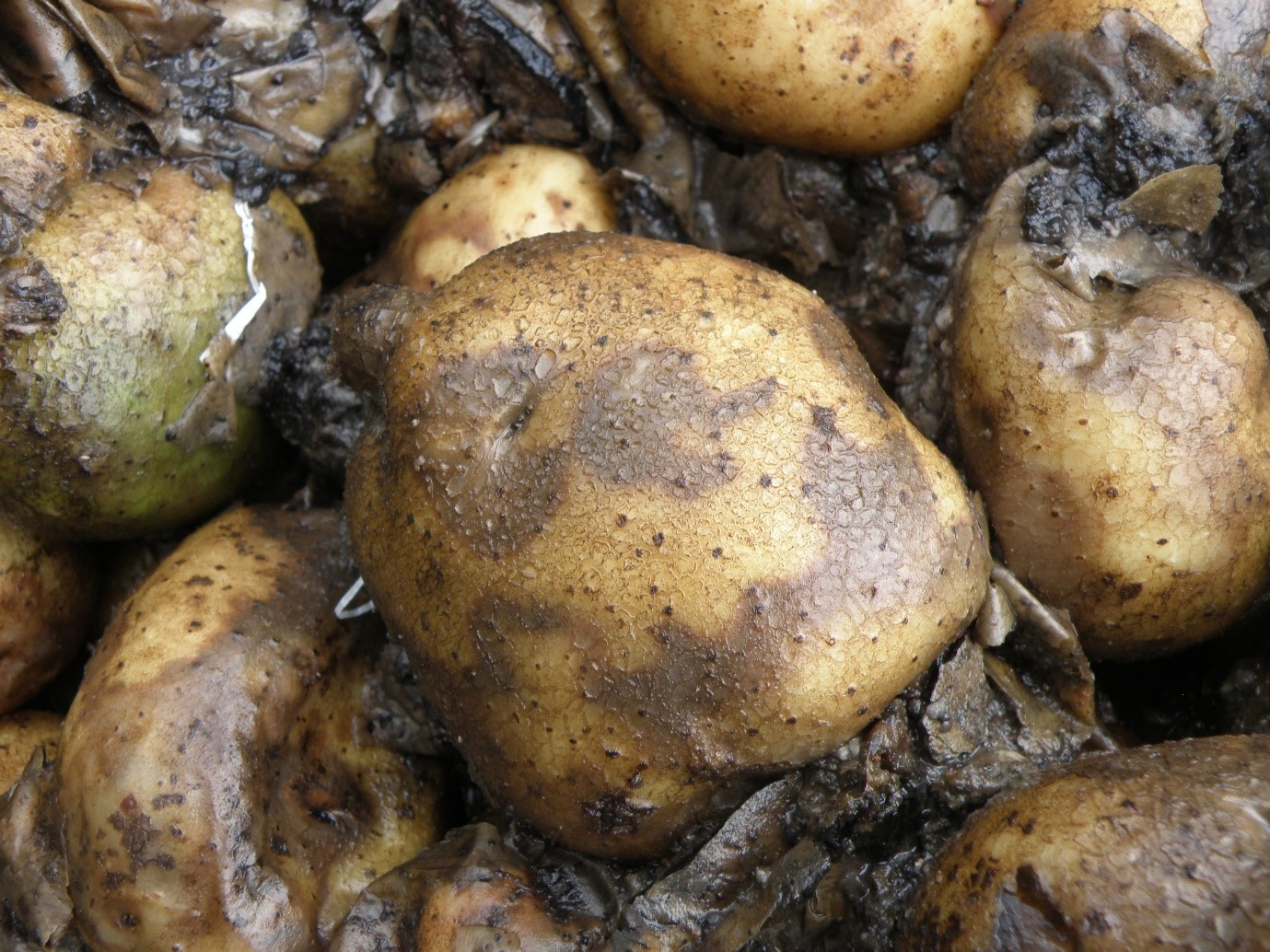
Symptoms
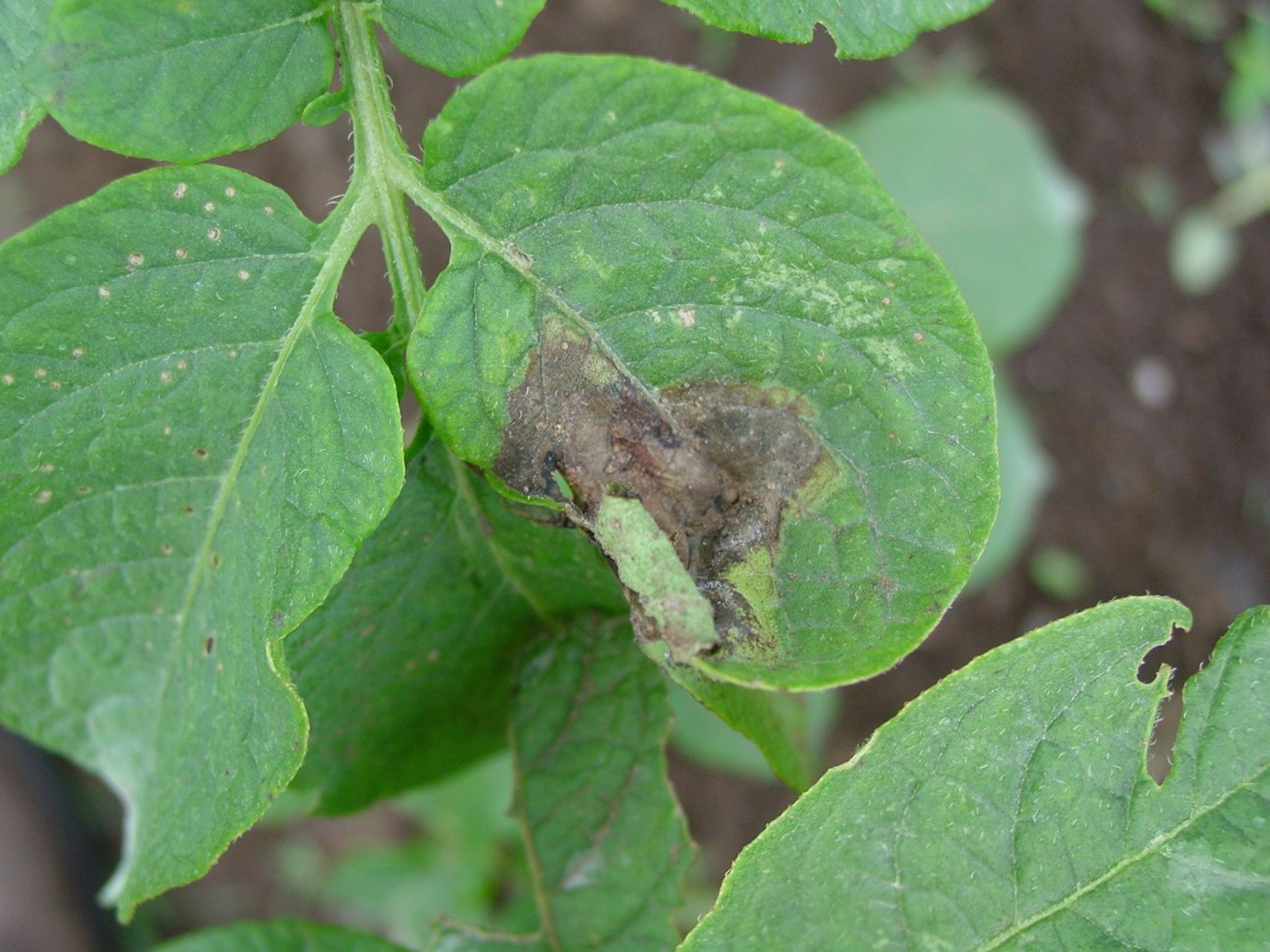
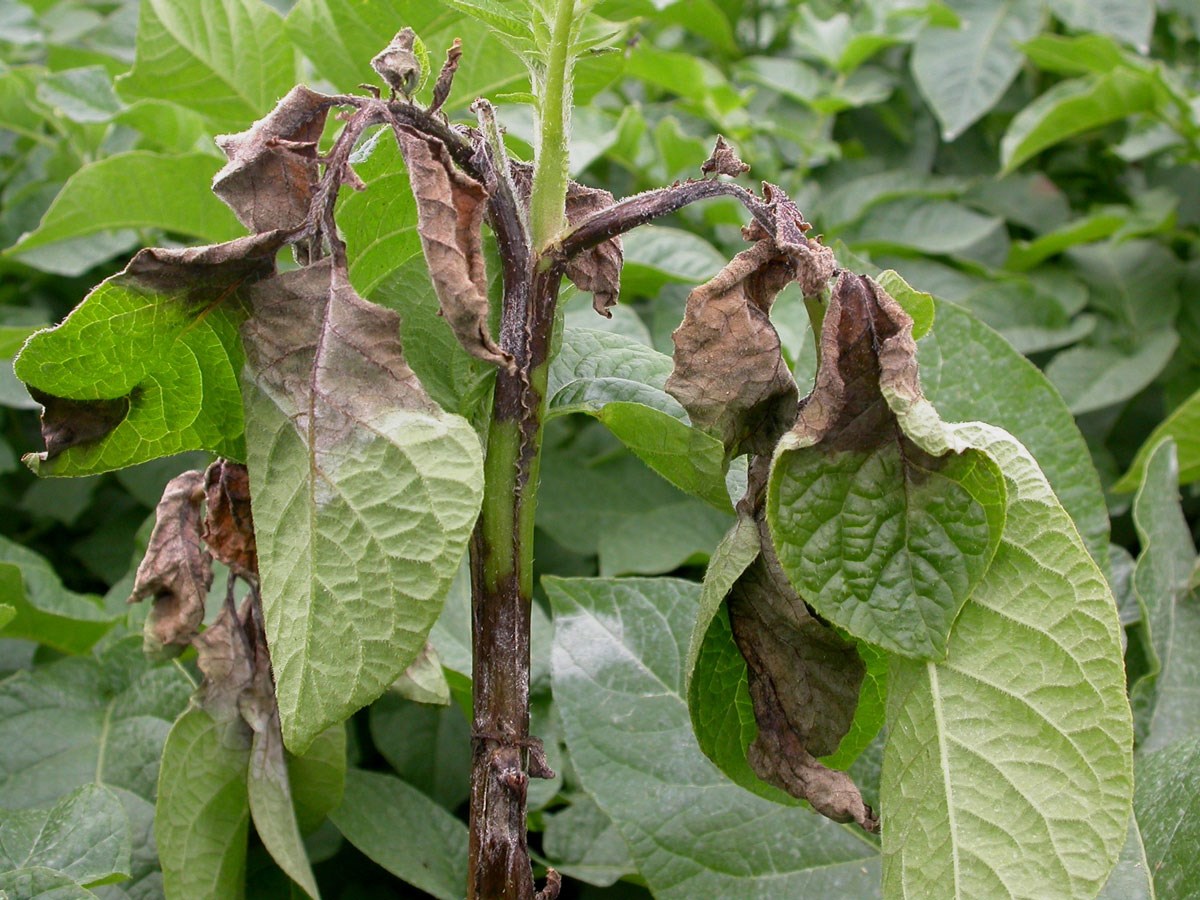
- The sickness harms leaves, stems, and tubers.
- It starts as small light green spots on leaves, which grow into big wet patches mainly from the tips or edges of leaves.
- A white mildew (fluffy growth) forms around the dead areas on the underside of leaves.
- Affected leaves look wrinkled as if they've been burned by hot water and eventually decay and dry up. When drying, leaves become brown or black.
- In dry weather, wet areas on leaves turn brown and dead.
- On stems, there are light brown stretched patches formed which might circle the stem. Infected stems start turning black from the tips and eventually dry out.
- Serious infections lead to all leaves rotting, drying out, and falling off, stems drying out, and plants dying.
- Tubers get reddish-brown, shallow to deep, dry rotten patches. The inside of the affected tuber turns 'caramelized' with a sugary feel.
- Often, a metallic sheen develops on the edges of the affected tissue.
- This disease works very fast. Without control, infected plants will die in two or three days.
Management
- Before storing, carefully inspect seed potatoes.
- Remove and deeply bury any tubers affected by blight.
- Build ridges high enough to cover all daughter tubers and lower their risk of getting infected.
- Clean up and get rid of any leftover plant debris and other plants that could host the disease in the field.
- If the weather conditions (temperature 10-20°C, humidity >80%) are good for the disease to spread, stop watering right away. If needed, only lightly water.
- When 75% of the crop's leaves are affected by the disease, cut and remove the stems from the field, burying them deeply. Wait 2-3 weeks after removing the stems before digging up the tubers.
- Choose varieties of potatoes that grow quickly.
- Plant potato varieties that are resistant to the disease, such as Kufri Naveen, Kufri Khasigaro, Kufri Jeevan, Kufri Alankar, Kufri Badshah, Kufri Muthu, Swarna, etc.
- Use fertilizers carefully.
- Avoid letting the soil get waterlogged.
Chemical Control
| Sl.No | Generic Name | Trade Name | Color code | Dosage/litre | Knapsack Sprayer (Capacity 10L) | Recommendation | Remarks | |
|---|---|---|---|---|---|---|---|---|
| Dosage/acre (200 L) | Dosage/hectare (500 L) | |||||||
| 1 | Copper oxychloride 50 WP | Bensaan, Blitox, Blue copper, Bluetrox, Copter, Cupramar, Cuprina, Dhanucop, Fytolan, Fytox, Fytran, Fytolan, Hilcopper, Killex copper, Maincop Dhanucop, Star cop, Tagcop, Trucop | Blue | 2 g | 20 g | 400 g | 1000 g | |
| 2 | Mancozeb 75 WP | Devidayal M-45, Dhanuka M 45, Dhanuka M-45, Dithane, Dithane M-45, Hilthane, Hindustan M 45, Indofil M 45, Izeb M-45 Manzate, Luzen-45, Macoban, Macoban M-45, Mancosaan, Mancosaan M-45, Maneb Manzane, M-Guard, Savour M 45, Tata M-45 Eurofil-NT, Uthane M-45, Veera, Zinthane | Green | 3 g | 30 g | 600 g | 1500 g | |
| 3 | Potassium phosphonate 40 SC | Akomin | Green | 4 ml | 40 ml | 800 ml | 2000 ml | Drench and spray |
| 4 | Fosetyl-Al 80 WP | Aliette | Green | 2 gm/L | 20 g | 400 g | 1000 g | Drench and spray |
| 5 | Copper hydroxide 77 WP | HiDice, Kocide 101 | Blue | 1 g | 10 g | 200 g | 500 g | |
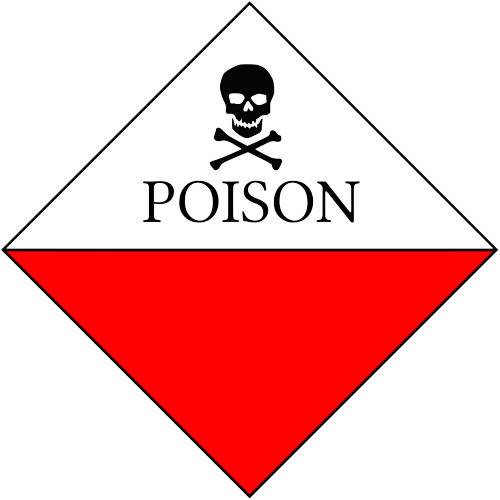
Extremely Toxic

Highly Toxic

Moderately Toxic