Good health, vigorous growth and intensive branching habit with panicles having high
percentage of hermaphrodite flowers.
Trees of 15-25 years of age.
Bearing nuts of medium size and weight (5-8 g/nut) with an average yield of 15 kg nuts per
annum.
Bearing 7-8 nuts per panicle Selection of nuts
Select mother trees in February and collect seed nuts in March-April.
Select good, mature, medium sized nuts (7 - 9 g), which sink in water as seeds after drying in sun for
two to three days. Raising seedlings
Raise seedlings in polythene bags during May.
Use polythene bags of size 20 cm x 15 cm and fill the bags with garden soil, leaving a gap of
1 to 1.5 cm above.
Soak seed nuts in water for 18 to 24 hours to hasten germination.
Sow the pre-soaked seed nuts in polythene bags filled with garden soil at a depth of 2-3 cm
with the stalk end up.
Seeds germinate in seven to ten days.
2. Propagation by air layering
Prepare air layers during February-March, so that they will be ready for planting in June-July.
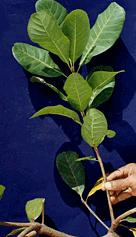
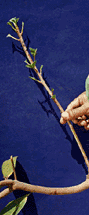
Select 9-12 months old pencil-thick terminal shoots.
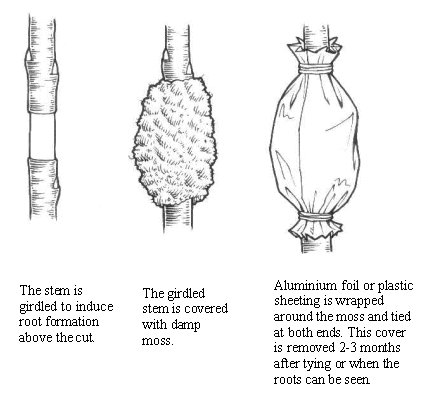
Remove carefully a strip or ring of bark, 0.6 to 1.2 cm thick by using a sharp knife without
injuring the underlying wood.
Wind a string around the cut area and cover it with moist moss or wood shavings or sand and
saw dust mixture or ordinary potting mixture and wrap round with 150-200 gauge polythene
film of size 23 cm x 15 cm.
Secure loose ends of film with jute fibre. When roots emerge from the ringed portion in 40-60
days, give a ‘V’ cut at lower end of treated shoot.
After about 15 days, deepen the cut slightly.
Cut and separate rooted shoot about 7 days later.
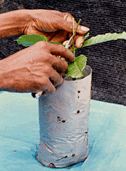
Pot the layers immediately after separation from the tree into containers of size 15 x 15 cm
made from coconut husk and keep them in shade.
Avoid excessive watering.
Plant the layers along with the container in the prepared pits with the onset of southwest
monsoon.
Provide shade and mulch with dry leaves to reduce sun-scorch in tender plants.
It is advisable to defoliate the layers two weeks before separation from the mother plant.
3. Propagation by grafting / budding
Different methods of grafting viz., epicotyl grafting, softwood grafting, veneer grafting, side
grafting, patch budding etc. have been tried in cashew with varying degrees of success.
Among them, softwood grafting was found to be the best for commercial multiplication of
cashew.
Types of grafting
a) Softwood grafting
Selection of seed nuts
Seed nuts may be collected during the peak period of harvest (February-March) and sundried
for 2-3 days.
Quality seed nuts may be selected by immersing in water or 10 per cent saline solution.
Seeds, which sink in water, may be selected.
Medium sized nuts (7-9 g) may be selected to get vigorously growing seedlings.
Raising rootstocks
Fresh seed nuts are to be used for raising rootstock. Seed nuts stored for more than one year
may be avoided.
The seed nuts should be soaked in water overnight before sowing.
Use polythene bags (size 25 cm x 15 cm,300 gauge thickness) for filling potting mixture.
Punch about 16-20 holes on the polythene bags to ensure good drainage.
Prepare the potting mixture (1:1:1 ratio of red soil, river sand and compost) mixed with rock
phosphate @ 5 g per 2 kg potting mixture.
Fill the polythene bags up to the brim of the bag.
Sow the pre-soaked nuts in the centre of the bag with stalk end up, at a depth of 2.0-2.5 cm.
Water the bags immediately after sowing and daily thereafter.
Avoid excess irrigation.
Nuts usually germinate within 15-20 days after sowing during monsoon months and within 8-
10 days during dry months.
Nuts should be sown at weekly intervals to get continuous supply of rootstocks.
During summer, provide partial shade to the seedlings till they change their bronze colour to
green and then keep them in the open.
The seedlings will be ready for grafting in 50-60 days after germination.
Prevent damage to germinating nuts from squirrels, birds etc.
During the rainy season, damping off of young seedlings is common.
To control this disease, spraying / drenching Bordeaux mixture (1per cent) is effective.
Selection of rootstock
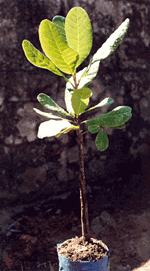
Select 50-60 days old healthy seedlings having single main stem grown in the centre of the
polythene bag, as rootstock.
Selection of scions
Select a high yielding variety of cashew as mother plant to collect adequate number of scions.
Select 3-5 month old non-flowering lateral shoots of current season’s growth.
The selected scions should be 10-12 cm long, straight, uniformly round and pencil thick with
brown colour having dormant plumpy terminal bud.
The top 4-5 leaves should be dark green in colour indicating proper maturity of the scion.
Pre-curing
Pre-cure the selected scions by clipping
off three fourth portion of leaf blades.
Scions will be ready for grafting in 7-10 days after leaf removal.
Collection of scions
The pre-cured scions are to be cut early in the morning to avoid desiccation.
The scions should be collected before the terminal buds sprout. (3)
Wrap scions in moist cloth and put in polythene covers as soon as they are cut from the
mother tree and bring them to the nursery for grafting.
If necessary, they can be stored for 3-4 days and used for grafting.
Preparation of rootstock
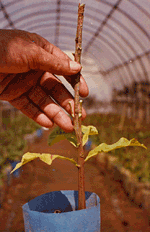
Retain two pairs of bottom leaves and remove others from the selected seedlings
using a sharp knife.
Give a transverse cut on the main stem, 15 cm above ground level.
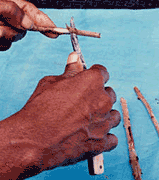
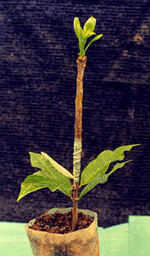
A cleft of 4-5 cm deep is made in the middle of the decapitated stem of the seedling by giving
a longitudinal cut.
Preparation of scion
Select a matching scion stick (same thickness as that of the rootstock).
The cut end of the scion is shaped to a wedge of 4-5 cm long by chopping the bark and wood
from two opposite sides.
b) Wedge Grafting
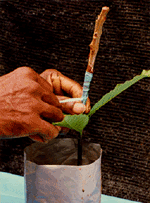
The wedge of the scion is inserted into the cleft of the rootstock, taking care to ensure that
the cambium layers of stock and scion are in perfect contact with each other.
The graft joint is secured firmly by a polythene tape (1.5 cm wide and 30 cm long).
The scion of the graft is to be covered with a wet polythene cap (15 cm x 12.5 cm. 100
gauge thickness) and tied at the bottom to maintain humidity inside and to protect the
apical bud from drying.
The polythene cap should not touch the terminal bud.
A narrow polythene cover of size 20 cm x 3 cm (sip-up-cover) can also be used instead of
above said polythene cap.
The grafted plants are to be kept under shade for 10-15 days to enable sprouting of the
terminal buds.
The polythene caps are to be removed and the grafts shifted to open place.
The successful grafts show signs of growth within 3-4 weeks after grafting.
The grafts will be ready for planting 5-6 months after grafting.
The success in softwood grafting is more during the period from March to September
under Kerala conditions.
Care in the nursery
The grafts are to be watered regularly using a rose can or micro-sprinkler.
Remove new sprouts emerging from rootstock at frequent intervals.
Panicles, if produced by the grafts, may be removed as and when observed.
Grafts should be placed on polythene sheets spread on the ground to prevent rooting.
Shift the grafts frequently from one place to another to prevent them from striking roots
into the ground.
Spray recommended insecticides for controlling the infestation of sucking insects as and
when required.
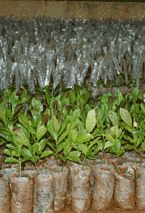
Graft production under polyhouse
Softwood grafts can be prepared almost throughout the year with a mean graft success of
about 60-70 per cent.
Higher success is achieved during the monsoon season.
For this, low cost polyhouses (prepared from casuarina/bamboo poles/areca reapers / GI
pipes/PVC pipes and covered with high density polythene sheet of convenient
dimensions) preferably 20 m long and 6 m wide may be utilized for graft production.
The height of the polyhouse should be 2.5 m in the middle and 1.0 m on both sides.
The plants may be watered using hose.
Misting units can also be fitted at appropriate points and switched on for about 5-10
minutes at an interval of two hours from 10 a.m. to 6 p.m. during summer season. This
reduces the temperature build up inside the polyhouse.
Raising of rootstock seedlings, grafting of rootstocks and maintenance of grafts can be
done inside the polyhouses. These polyhouses give protection to the seedlings and grafts
during heavy rains and reduce the mortality.
Again during summer months the seedlings/grafts can be maintained in these polyhouses
by covering with HDPE shade nets (35-50 per cent shade).
Planting
Planting and management of grafts
The softwood grafts will be ready for planting in 5-6 months after grafting.
The pits are filled with topsoil and 5-10 kg of compost or dried cowdung / pit and the
grafts are planted after carefully removing the polythene bags.
Care should be taken while planting to see that the graft union is 2.5 cm above the ground
level.
The polythene tape is to be carefully cut and removed subsequently.
Staking should be done immediately after planting to avoid lodging.
Planting and management of plantation
Plant softwood grafts in pits of size 50 cm x 50 cm x 50 cm during June-July.
Planting may be done at a spacing of 7.5 m for poor and 10 m for rich and deep soils and
sandy coastal area.
On very sloppy lands, the rows may be spaced 10-15 m apart with a spacing of 6-8 m
between trees in a row.
Depending upon the weed growth, weeding operation may be done during August-
September.
Mulch the plant base with dry leaves to reduce sun-scorch to tender plants.