

Ginger (Zingiber officinale)
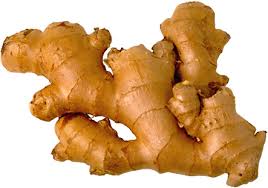
Ginger is one of the earliest known oriental spices and is being cultivated in India both as a fresh vegetable and as a dried spice since time immemorial. Ginger is obtained from the rhizomes of Zingiber officinale. The ginger family is a tropical group especially abundant in Indo-Malaysia, consisting of more than 1200 plant species in 53 genera. The genus Zingiber includes about 85 species of aromatic herbs from East Asia and Tropical Australia. The word ginger is derived from a Sanskrit word singabera meaning 'shaped like a deer's antlers (horn)'. Ginger is not known in a wild state and has been cultivated for so long a period in both China and India that its exact origin is unclear. It is believed to be a native of Southern Asia. Kerala and Meghalaya are the major ginger growing states in the country.
Ginger, reached the West at least two thousand years ago, recorded as a subject of a Roman tax in the second century after being imported via the Red Sea to Alexandria. Tariff duties appear in the records of Marseilles in 1228 and in Paris by 1296. Rosengarten (1969) recorded that ginger was mentioned by the Chinese philosopher Confucius (551-479 BC). Its medicinal properties are mentioned by Dioscorides (1 century A.D) in his D. Materia Medica. It was introduced to Germany and France in the ninth century and to England in the tenth century. Ginger is known in England before the Norman Conquest, as it is commonly found in the 11th century Anglo-Saxon leech books. Ginger is detailed in a 13th century work, "Physicians of Myddvai," a collection of recipes and prescriptions written by a physician, Rhiwallon, and his three sons, by mandate of Rhys Gryg, prince of South Wales (who died in 1233). By the 13th and 14th centuries it was familiar to English palates, and next to pepper, was the most popular spice. Ginger, as a product of the Far East, was indelibly imprinted on the taste buds of Westerners before potatoes, tomatoes, and corn were even known to exist by Europeans.
Arabs took it from India to East Africa (13th century). The Portugese Mendoja, introduced ginger into Mexico soon after the discovery of that country. They in turn introduced in Jamaica. Since the ginger rhizomes can be easily transported in a living state, the plant has been introduced to several tropical and sub-tropical countries. Ginger is now commercially cultivated in nearly every tropical and subtropical countries in the world with arable land for export crops. The major production is in India, Jamaica, Nigeria, Sierra Leone, Brazil, China, Japan, Indonesia, Taiwan and Australia. Jamaica and India produce the best quality ginger. In India, about 70% of the total ginger production is confined to Kerala. Other states that grow ginger are Assam, Andhra Pradesh, Himachal Pradesh, West Bengal and Sikkim.
Aroma and Flavour
Ginger, being a major spice, has many uses in food, flavouring and medicinal products. The aroma of ginger is pleasant and spicy and flavour penetrating, pungent and slightly biting. It is a common ingredient in Asian cooking and it flavours several products like confectionary, gingerole, curry powders, pickles, several soft drinks and alcoholic beverages. It is also essential in Western baking like in traditional gingerbreads, cakes, biscuits etc. It is available fresh and preserved in brine or syrup. Besides these, ginger oils and oleoresins also have a variety of uses. The essential oil is used in commercial flavourings.