

Ginger (Zingiber officinale)
Rhizome rot/ soft rot (Pythium graminicolum, P. aphanidermatum)
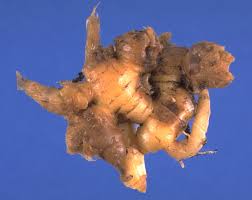
Symptoms
- The infection starts at the collar region of the pseudostem and progresses upwards as well as downwards.
- The collar region of the affected pseudostem becomes water soaked and the rotting spreads to the rhizome resulting in soft rot.
- At a later stage also, root infection is noticed.
- Foliar symptoms appear as light yellowing of the tips of lower leaves which gradually spreads to the leaf blades.
- In early stages of the disease, the middle portion of the leaves remain green while the margins become yellow.
- Later, the yellowing spreads to all leaves of the plant from the lower region upwards and is followed by drooping, withering and drying of pseudostems.
Management
- Use of resistant varieties to rhizome wilt/ rot.
- Crop rotation with maize, cotton, soybean.
- Planting of disease-free seed rhizomes.
- Flooding treatment for 30 days, soil solarisation during hottest months for 60 days
- Treat the rhizomes with hot water at 51° C for 10 minutes.
- Use bio-fumigation using cabbage and mustard plant refuses.
- Application of pine needle and neem cake powder treatments @ 100 Kg/ acre (in two splits)
Chemical Control
| Sl.No | Generic Name | Trade Name | Color code | Dosage/litre | Recommendation | Remarks | |
|---|---|---|---|---|---|---|---|
| Dosage/acre (200 L) | Dosage/hectare (500 L) | ||||||
| 1 | Mancozeb 75 WP | Devidayal M-45, Dhanuka M 45, Dhanuka M-45, Dithane, Dithane M-45, Hilthane, Hindustan M 45, Indofil M 45, Izeb M-45 Manzate, Luzen-45, Macoban, Macoban M-45, Mancosaan, Mancosaan M-45, Maneb Manzane, M-Guard, Savour M 45, Tata M-45 Eurofil-NT, Uthane M-45, Veera, Zinthane | Green | 3 g/litre of water | 600 g | 1500 g | |
| 2 | Potassium phosphonate 40 SC | Akomin | Green | 4 ml/litre of water | 800 ml | 2000 ml | |
| 3 | Mancozeb 64 + Metalaxyl 8 WP | Syscon | Blue | 2 g/litre of water | 400 g | 1000 g | Both spraying and soil drenching |
Extremely Toxic

Highly Toxic

Moderately Toxic