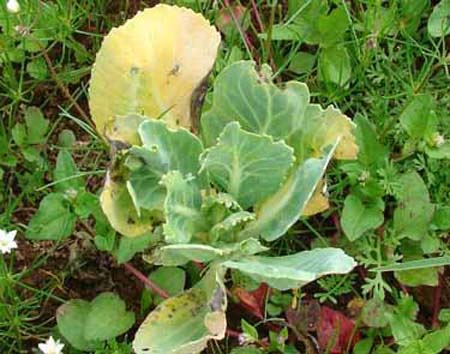
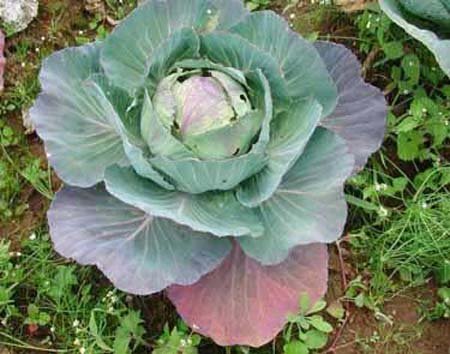
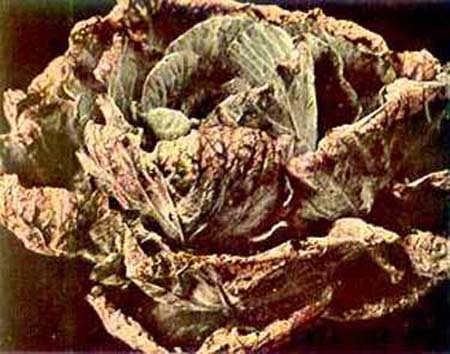
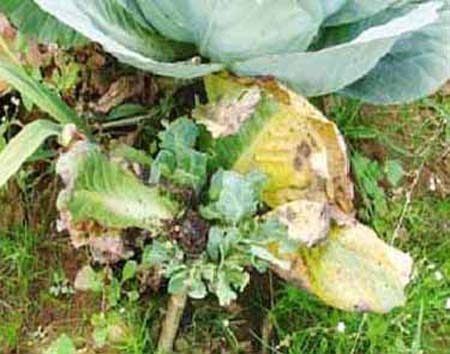
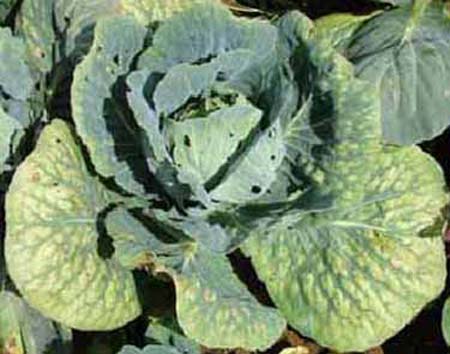
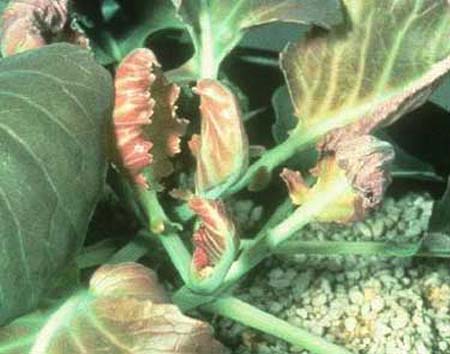
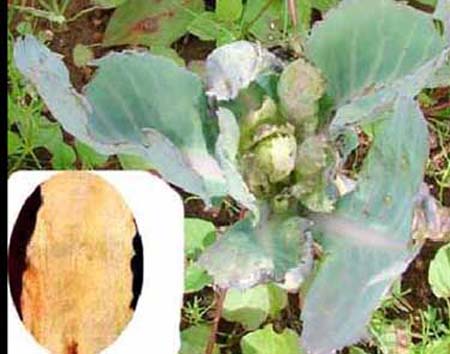
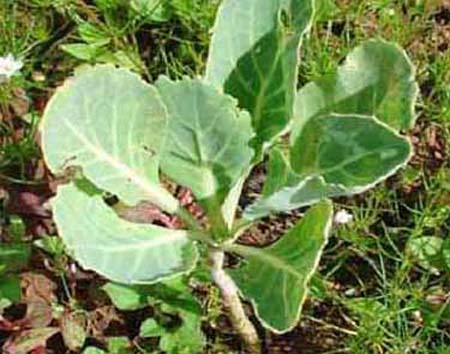
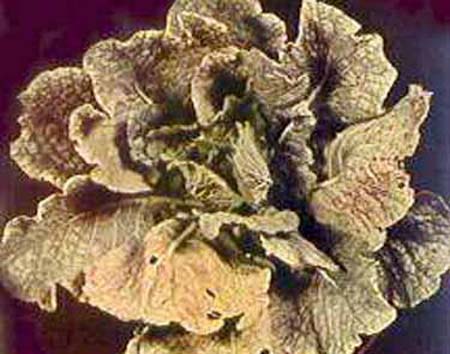
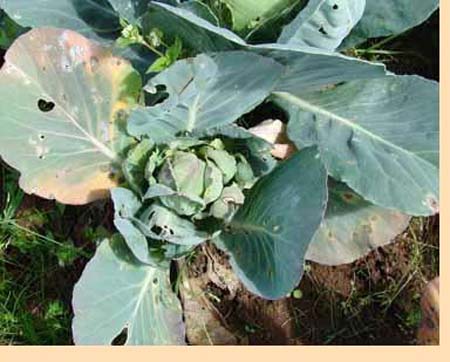
Deficiency symptoms will be first noticed in older leaves.
Leaves becomes yellowish-green
Death and / or dropping of the older leaves.
Stunted plant growth
Some leaf parts may have a reddish or orange flush.
Decay of older leaves
No or small head is formed – Buttoning of cabbage
Management
For determining the severity of the deficiency, soil analysis has to be done
Application of quick releasing nitrogen fertilizer like urea, according to the results of the soil test.
Apply urea as a foliar spray (10 gram per litre of water) once every 15 days
Frequent application of organic growth boosters is also beneficial
Phosphorus (P)
Symptoms
Deficiency symptoms will be first noticed in older leaves.
Pink discoloration on leaves
Reduced curd size and quality
Marginal chlorosis and premature death
Stunted growth of plants.
Reduced root growth
Management
Ensure that recommended amount of fertilizer is applied on regular time.
For determining the severity of the deficiency, soil analysis is to be done
Use fertilizers such as single superphosphate for quick correction or bone meal or rock phosphate for long-term correction.
In the pH range of 6.2-7.0, phosphorus is readily absorbed by the roots.
Addition of biofertilizers including phosphorus solubilizing bacteria along with organic manure helps to increase the availability of phosphorus
Potassium (K)
Symptoms
Deficiency symptoms will be first noticed in older leaves
White, yellow, or orange chlorotic spots or stripes on older leaves starting from the leaf tips and margins.
Leaf base usually remains dark green.
Leaf margins are cupped upwards
Light brown and withered necrosis on leaves
Mature heads are loose and smaller
Crinkled leaf surface
Marginal necrosis of leaf
Management
In the pH range of above 6, potassium is readily available.
Maintain pH by addition of lime/dolomite
Improve the soil fertility by adding organic matter and wood ash.
For determining the severity of the deficiency, soil analysis is to be done
Use Muriate of Potash (MOP) according to the results of the soil test. Split application is preferable.
Apply foliar sprays of Sulphate of Potash (SOP) (10 g/litre of water) and wetting agents in the morning as an immediate remedy
Calcium (Ca)
Symptoms
Deficiency symptoms will be first noticed in younger leaves
“Tip-burn" symptom - necrotic lesions on leaf tips and margins
Reduced leaf growth
Scorching of young leaves
Reduced internodal length and rosetting of leaves
Stunted growth of plants
Ragged and often brittle leaf margins
Breakdown of the heart and dieback of rootlets
Severely stunted and no heads are formed in severe deficiency
Management
Do the soil analysis
Check the pH of the soil. If the soil is extremely acidic (pH between 3.5 and 4.5), apply lime (3.4 kg/cent in two split doses). And in areas of moderate acidity (pH between 5.5 and 6), apply lime 1 kg/cent.
High phosphorus levels lead to calcium deficiency.
In alkaline soil application of Gypsum is preferable
Boron is needed for calcium utilization.
So, a boron deficiency can also lead to calcium deficiency.
Magnesium (Mg)
Symptoms
Symptoms first appear on those leaves just reaching their full size
interveinal chlorosis.
The small veins also become chlorotic, but the bigger ones remain green
Stunted growth of plants
Reduced leaf growth
Chlorosis and spotted necrosis of leaves
Premature leaf abscission
Management
Do the soil analysis and confirm the deficiency.
Addition of Magnesium sulphate (32 kg/ acre) in bands near plants.
Long-term usage of dolomite will reduce magnesium deficiency
Magnesium and potassium fertilizers should not be applied together
Sulphur(S)
Symptoms
Deficiency symptoms first appear in younger leaves.
Chlorosis followed by general yellowing
Delayed green colour development in newly emerged leaves
Young leaf become purplish in colour
Upward curling and roll in of leaves
Stunted growth of plants
Head forming is inhibited
White succulent brittle leaf
Management
Application of sulphur-containing fertilisers, such as Factamfos, Ammonium sulphate, Single superphosphate, etc., reduces the deficiency.
In sulphur deficient soils, apply sulphur dust (10 kg/acre).
Deficiency in alkaline soil can be reduced by application of gypsum
Addition of organic material improves sulphur availability in the soil
Burning of organic waste leads to sulphur deficiency
Boron (B)
Symptoms
Deficiency is seen mainly in younger leaves
Yellowing and browning of leaf tips
Malformed newly emerging leaves
Stunted growth.
Trunk is hollow and brownish coloured cavity
Bitter taste of head
Thick brittle and irregular chlorosis on leaves
Chlorotic mottling on the edges and between the veins
Management
Analysis of soil to confirm the deficiency.
Application of borax (4 kg/ acre) into the soil
Addition of borax (1 gram / litre of water) as foliar spray
Avoid the combined application of Boron and calcium.
Application of borax with ammonium fertilizers should be avoided.
Iron (Fe)
Symptoms
Deficiency symptoms first appear on young leaves
Interveinal chlorosis
Yellow leaves with dark green veins
Entire plant become light green in colour
stunted plant growth
Reduced size of leaves
Petioles are somewhat longer
Management
Iron content in Kerala soils is often high. So, get a soil test to determine the reason for the problem
Low potassium levels lead to iron deficiency
Addition of Ferrous Sulphate (6 kg/ acre) into the deficient soils.
Manganese (Mn)
Symptoms
Deficiency symptoms first appear on those leaves just reaching their full size
Marginal chlorosis of young leaves
Interveinal chlorosis
Leaf blades are enlarged, but not cupped inwards as usual
Yellowish - green mottle between the main veins with dark green band
Management
Soil Analysis
Application of Manganese Sulphate (2 gram per litre of water) as foliar spray
Zinc (Zn)
Symptoms
deficiency symptoms first appear on young leaves
Interveinal chlorosis of leaves with whitening
Leaves are small and distorted with a rosette form.
Little leaf symptoms
Head size is reduced
Stunted growth of plants
Management
The optimal pH range for zinc availability is 5 to 7.5.
Confirm deficiencies by doing soil testing.
Apply zinc sulphate to deficient soils (8 kg/ acre)
Avoid the application of zinc and phosphate fertilizers at the same time
In severe cases, foliar spraying of zinc sulphate (2 gram/litre of water) with Calcium carbonate (2.5 gram/litre of water) can be advocated in morning hours.