

Potato (Solanum tuberosum)
Black scurf/ canker(Rhizoctonia solani)
Symptoms
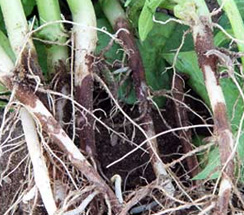
- The disease commonly affects various parts of the potato plant, including tubers, sprouts, stems, and stolons.
- A prevalent symptom is the presence of black scurf, appearing as dark brown to black irregular lumps firmly attached to the tuber surface.
- These lumps adhere closely to the tuber and are difficult to wash off.
- Additional tuber symptoms include skin cracks, crater-like depressions, pitting, stem-end necrosis, and shape deformities.
- Sprout injury is a common occurrence, both in storage and in fields post-planting, characterized by tissue discoloration.
- Heavily infected sprouts may fail to emerge from the soil, leading to patchy germination.
- Emerging sprouts may develop cankers, causing the girdling of stem bases, resulting in upward rolling of leaves with pinkish or purplish margins.
- Often, small green or reddish aerial tubers form in the axils.
- The infection can also spread to roots and developing stolons, leading to rotting of cortical tissues.
- Infected roots may subsequently shed, resulting in plants with poor root systems, while infected stolons produce deformed tubers.
Management
- Utilizing treated seed continuously over 2-3 crop seasons has been observed to effectively control the disease.
- Implementing crop rotation with maize or 'dhaincha' (Sesbania aegyptiaca) for green manure aids in suppressing disease buildup.
- Planting disease-free and healthy tubers proves beneficial in reducing disease incidence.
- Employing a rotation schedule of two to four years with cereals, brassicas, and legumes aids in disease management.
- Increasing the organic matter content in soil helps diminish fungus populations by enhancing the activity of antagonist microorganisms.
- Proper disposal of crop debris is essential for disease control.
- Prudent use of fertilizers is recommended for disease management.
- Implementing good drainage, shallow planting depths, and weed eradication practices contribute to disease reduction.
- Seed tuber treatment with Trichoderma viride or Pseudomonas fluorescens (20gm/L of water)
- Seedling dips in Trichoderma viride or Pseudomonas fluorescens (20gm/L of water) reduces the disease.
- Soil Application of Trichoderma viride or Pseudomonas fluorescens multiplied in neemcake and organic manure also reduces incidence of the disease.
Chemical Control
| Sl.No | Generic Name | Trade Name | Color code | Dosage/litre | Knapsack Sprayer (Capacity 10L) | Recommendation | Remarks | |
|---|---|---|---|---|---|---|---|---|
| Dosage/acre (200 L) | Dosage/hectare (500 L) | |||||||
| 1 | Carbendazim 50 WP | Bavistin, Benfil, Bengard, Benlate, Benmain, Bensaan, Carben, Carziim50, Dhanustin, Dhanustin 50 WP, Fungiguard, Gancarzin50, Glizim, Mintho, Tagstin, Tiara, Zoom | Green | 2 g | 20 g | 400 g | 1000 g | Seedling treatment |
| 2 | Copper oxychloride 50 WP | Bensaan, Blitox, Blue copper, Bluetrox, Copter, Cupramar, Cuprina, Dhanucop, Fytolan, Fytox, Fytran, Fytolan, Hilcopper, Killex copper, Maincop Dhanucop, Star cop, Tagcop, Trucop | Blue | 2 g | 20 g | 400 g | 1000 g | Soil Drenching |
| 3 | Copper hydroxide 77 WP | HiDice, Kocide 101 | Blue | 1 g | 10 g | 200 g | 500 g | Soil Drenching |
Extremely Toxic

Highly Toxic

Moderately Toxic