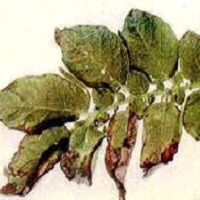
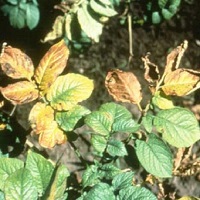
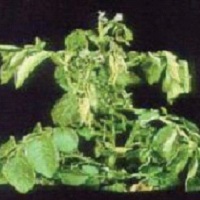
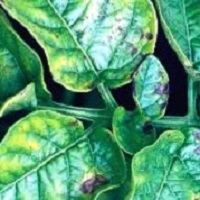
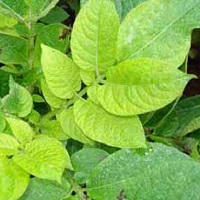
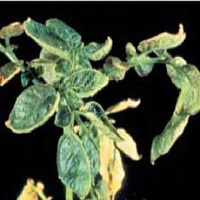
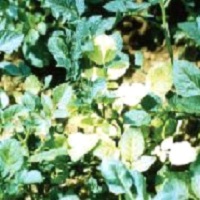
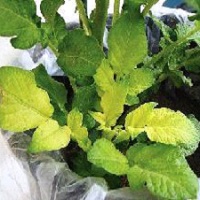
A noticeable purpling occurs on the stem, petiole, and the undersides of leaves.
Plants remain stunted and exhibit a darker-than-normal coloration.
The lower leaf surface takes on a gray-green appearance.
Leaflets curl upward, particularly severely in cases of severe deficiency.
Management
Ensure that recommended amount of fertilizer is applied on regular time.
For determining the severity of the deficiency, soil analysis is to be done
Use fertilizers such as single superphosphate for quick correction or bone meal or rock phosphate for long-term correction.
In the pH range of 6.2-7.0, phosphorus is readily absorbed by the roots.
Addition of biofertilizers including phosphorus solubilizing bacteria along with organic manure helps to increase the availability of phosphorus
Potassium (K)
Symptoms
Potassium deficiency affects both young and mature leaves due to its high mobility within the plant.
Symptoms of potassium deficiency include crinkled leaflets, tip burn, and interveinal necrosis, which worsen as the deficiency progresses.
The interveinal areas of affected leaves become largely necrotic, while the veins maintain their green color.
This necrosis causes the leaves to curl and crinkle, eventually leading to a scorched appearance with black pigmentation and necrotic edges.
Unlike nitrogen deficiency, chlorosis resulting from potassium deficiency cannot be reversed, even with potassium supplementation.
Management
In the pH range of above 6, potassium is readily available.
Maintain pH by addition of lime/dolomite
Improve the soil fertility by adding organic matter and wood ash.
For determining the severity of the deficiency, soil analysis is to be done
Use Muriate of Potash (MOP) according to the results of the soil test. Split application is preferable.
Apply foliar sprays of Sulphate of Potash (SOP) (10 g/litre of water) and wetting agents in the morning as an immediate remedy
Calcium (Ca)
Symptoms
Chlorosis, reduced size, and slight curling are observed in young leaves and leaf tips.
Severe calcium deficiency can lead to stunted plant growth.
Symptoms primarily manifest in the apical parts of leaves, stems, and sprouts due to calcium's limited mobility within the plant.
Necrotic and black tips on sprouts, along with internal rust spots on tubers, may indicate inadequate calcium deficiency
Management
Do the soil analysis
Check the pH of the soil. If the soil is extremely acidic (pH between 3.5 and 4.5), apply lime (3.4 kg/cent in two split doses). And in areas of moderate acidity (pH between 5.5 and 6), apply lime 1 kg/cent.
High phosphorus levels lead to calcium deficiency.
In alkaline soil application of Gypsum is preferable
Boron is needed for calcium utilization.
So, a boron deficiency can also lead to calcium deficiency.
Magnesium (Mg)
Symptoms
Leaves deficient in magnesium display noticeable interveinal chlorosis.
Interveinal necrosis contributes to a scorched appearance in advanced cases.
Advanced magnesium deficiency may resemble potassium deficiency superficially.
Symptoms typically start with the development of mottled chlorotic areas between veins.
Initially, symptoms are observed on young, mature leaves.
Management
Do the soil analysis and confirm the deficiency.
Addition of Magnesium sulphate (32 kg/ acre) in bands near plants.
Long-term usage of dolomite will reduce magnesium deficiency
Magnesium and potassium fertilizers should not be applied together
Sulphur(S)
Symptoms
The leaves display overall chlorosis, with a noticeable reddish tint in the veins and petioles.
Yellowing is uniform across the entire plant, including young leaves.
Reddish coloring is often present on the undersides of the leaves.
Advanced sulfur deficiency can cause leaves to become more upright, twisted, and brittle.
Leaflet yellowing is uniform and widespread in cases of sulfur deficiency.
Management
Application of sulphur-containing fertilisers, such as Factamfos, Ammonium sulphate, Single superphosphate, etc., reduces the deficiency.
In sulphur deficient soils, apply sulphur dust (10 kg/acre).
Deficiency in alkaline soil can be reduced by application of gypsum
Addition of organic material improves sulphur availability in the soil
Burning of organic waste leads to sulphur deficiency
Boron (B)
Symptoms
Boron-deficient leaves display a light general chlorosis.
Boron deficiency leads to necrosis in the growing region's meristematic tissues, resulting in loss of apical dominance and a rosette-like growth pattern.
Symptoms resemble those of calcium deficiency.
Leaves are unusually brittle and prone to breakage.
Even with adequate water supply, younger leaves may wilt, suggesting disrupted water transport due to boron deficiency.
Management
Analysis of soil to confirm the deficiency.
Application of borax (4 kg/ acre) into the soil
Addition of borax (1 gram / litre of water) as foliar spray
Avoid the combined application of Boron and calcium.
Application of borax with ammonium fertilizers should be avoided.
Copper (Cu)
Symptoms
Copper deficiency typically presents as a mild overall chlorosis, coupled with a permanent loss of turgor in young leaves.
Recently matured leaves exhibit a pattern of netted green veining, with some areas fading to a whitish-gray hue.
Certain leaves may develop sunken necrotic spots and display a tendency to bend downward.
Management
Apply copper sulphate (8 gram/cent or 800 gram/ acre in the soil).
Iron (Fe)
Symptoms
Leaves lacking iron display significant chlorosis at their bases, with some areas showing green netting.
Iron deficiency typically begins with interveinal chlorosis in the youngest leaves, progresses to overall chlorosis, and ultimately results in complete leaf bleaching.
Initial symptoms of iron deficiency are most noticeable in the youngest leaves due to iron's limited mobility within plants.
Iron deficiency is commonly linked to calcareous soils, anaerobic conditions, and excessive heavy metal presence.
In severe instances, the growing point and young leaves may turn yellow or white without necrosis, while veins and leaflet ends retain their green hue.
Management
Iron content in Kerala soils is often high. So, get a soil test to determine the reason for the problem
Low potassium levels lead to iron deficiency
Addition of Ferrous Sulphate (6 kg/ acre) into the deficient soils.
Manganese (Mn)
Symptoms
Light interveinal chlorosis is evident in the leaves due to manganese (Mn) deficiency.
Initial stages of manganese deficiency-induced chlorosis bear similarities to iron deficiency symptoms.
As stress escalates, dark necrotic areas develop along the veins of the leaves.
Leaf curling upwards occurs, accompanied by brown spotting on leaflets, especially along larger veins and mid-ribs.
Management
Soil Analysis
Application of Manganese Sulphate (2 gram per litre of water) as foliar spray
Zinc (Zn)
Symptoms
Interveinal necrosis is visible in the leaves.
Initially, zinc deficiency causes yellowing of younger leaves and pitting on the upper surfaces of mature leaves between veins.
Progression of the deficiency leads to intensified interveinal necrosis, with the main veins remaining green.
Management
The optimal pH range for zinc availability is 5 to 7.5.
Confirm deficiencies by doing soil testing.
Apply zinc sulphate to deficient soils (8 kg/ acre)
Avoid the application of zinc and phosphate fertilizers at the same time
In severe cases, foliar spraying of zinc sulphate (2 gram/litre of water) with Calcium carbonate (2.5 gram/litre of water) can be advocated in morning hours.