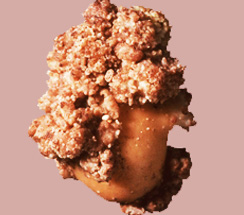
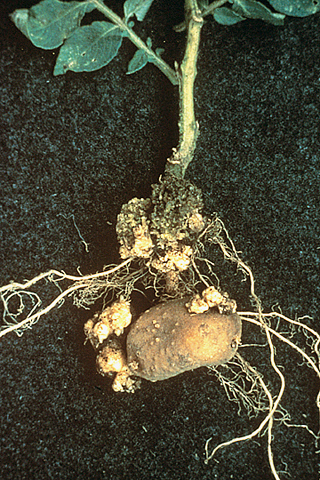
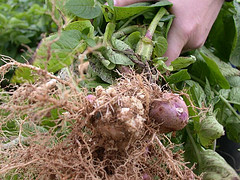
The disease exhibits cauliflower-like warty growths on tubers, stolons, and stem bases, excluding roots.
In wet conditions, it can present as a greenish-yellow crust on stems and leaves near or at ground level.
These warts are typically soft, pulpy, and spherical, matching the color of the tubers.
Exposure to sunlight may cause a color change in the warts, turning them green.
Entire tuber surfaces may occasionally be covered with these warts.
Over time, the tumors may darken, transitioning from their initial color to brown or black.
Secondary microorganisms can sometimes invade the wart tissues, leading to their decomposition.
Management
The primary mode of disease spread is through the use of wart-affected tubers as seed.
Additionally, the disease can spread via seeds of wart immune varieties grown in wart-infested soil, contaminated soil transported by humans, animals, or farm equipment, and manure containing diseased material.
Effective measures to control the spread include using disease-free potatoes as seed material and disposing of wart-affected lumps and potato peelings by burning.
Implementing crop rotation with non-host crops for a period of 8-10 years can help manage the disease.
Certain potato lines such as Rondo, Edina, and Mira from European countries have shown notable resistance to wart.
Varieties developed by CPRI, Shimla, such as Kufri Jyoti, Kufri Sherpa, Kufri Jeevan, and Kufri Muthu, have demonstrated resistance to both late blight and wart.