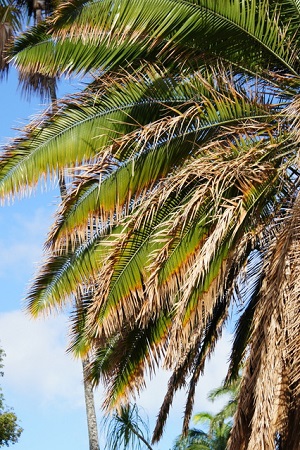
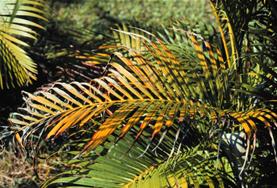
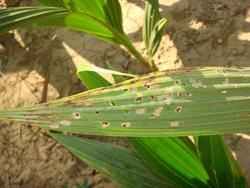
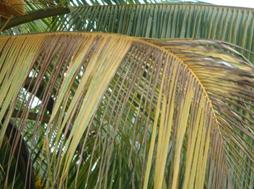
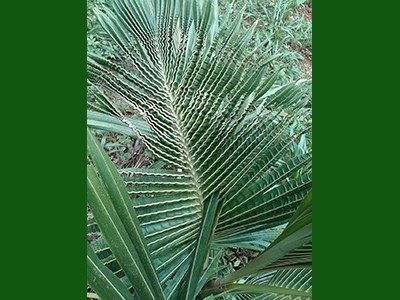
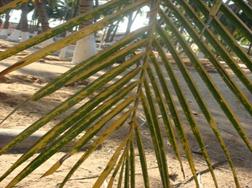
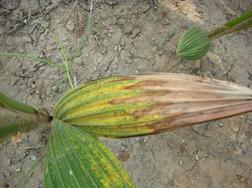
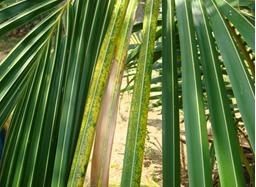
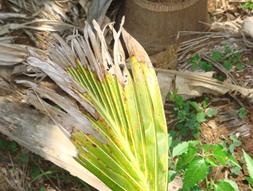
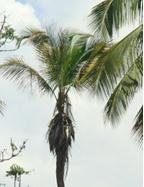
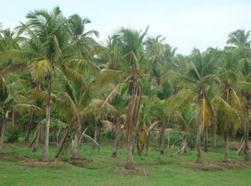
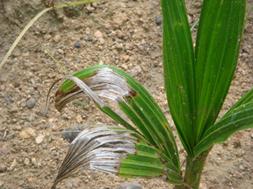
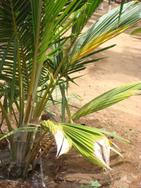
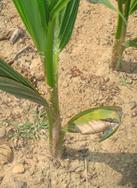
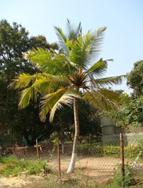
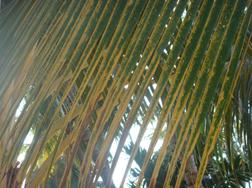
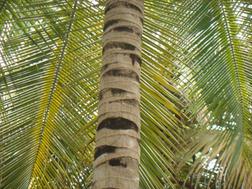
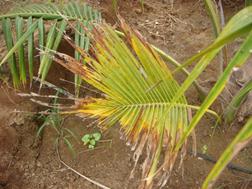
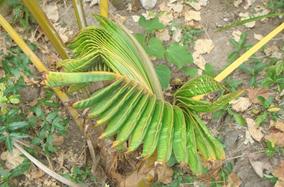
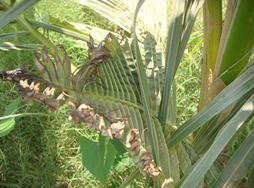
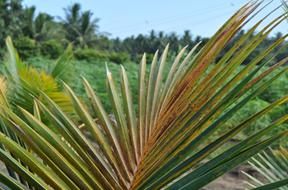
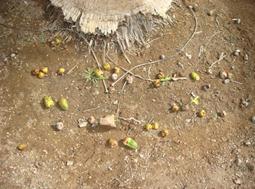
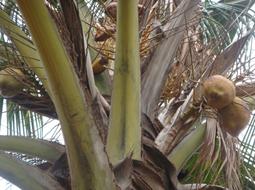
Chlorosis starts from older leaves to younger leaves
Leaves turn pale yellow or whitish in severe cases.
Coconut twigs in lower part of tree turn golden to reddish grey & eventually dies
At extreme deficiency shedding of leaves may occur
Development of new fronds take longer time to reach their full size.
Number of inflorescences are reduced
Lower production & yield
Stunted growth of the tree
Management
For determining the severity of the deficiency, soil analysis has to be done
Application of quick releasing nitrogen fertilizer like urea, according to the results of the soil test.
Frequent application of organic growth boosters is also beneficial.
Phosphorus (P)
Symptoms
Symptoms will be first noticed in older and lower leaves.
Under severe cases dark green or purple discoloration appear on leaves especially in older leaves.
Leaves are smaller than normal.
Shedding of leaves prematurely
Delayed fruiting & flowering are noticed.
Exhibit weak & underdeveloped root system results poor uptake of nutrients & water absorption.
Overall stunted growth of plant
Management
Ensure that recommended amount of fertilizer is applied on regular time.
For determining the severity of the deficiency, soil analysis is to be done
Use fertilizers such as single superphosphate for quick correction or bone meal or rock phosphate for long-term correction.
In the pH range of 6.5-7.5, phosphorus is readily absorbed by the roots.
Addition of biofertilizers including phosphorus solubilizing bacteria along with organic manure helps to increase the availability of phosphorus
Potassium (K)
Symptoms
Chlorosis or yellowing of older leaves progress to younger leaves.
Scorching/browning starting from the tip & progress towards base of the leaves
Scattered rust coloured spots on affected leaves are noticed.
Insufficiency leads to delayed flowering.
Fruits become smaller in size, thinner shelves
Decreased water content in coconut leads to reduced shelf life
Deficiency results lower oil content in copra
Over all weak & stunted growth of tree
Management
In the pH range of above 6, Potassium is readily available.
Maintain pH by addition of lime/dolomite
Improve the soil fertility by adding organic matter and wood ash.
For determining the severity of the deficiency, soil analysis is to be done
Use Muriate of Potash (MOP) according to the results of the soil test. Split application is preferable.
Opting for split application offers greater advantages. Dispose of palm wastes such as coconut leaves, crown waste, dried spathes, husk, etc., within the basin.
Alternatively, create a narrow trench with a suitable length, measuring 0.5 m to 0.75 m in width and 0.3 to 0.5 m in depth, positioned at a distance of 2-2.5 m from the tree base for this task.
Calcium (Ca)
Symptoms
Development of yellow spots appears on younger leaves and even on the spears
Leaves may exhibit brown / necrotic spots
Distorted, rolled & deformed leaves are noticed
Thinner & softer shelves are formed.
Leaf edges may curl & become irregular
Underdeveloped root sytem results into poor & less uptake of nutrients.
Overall size & weight of coconut become lesser.
More susceptible to diseases & pests.
Management
Analysis of pH in the soil
If the soil is acidic, add 1-2 kg of lime per palm per year in one or two split doses.
Dolomite can be substitute of lime
High phosphorus levels leads to calcium deficiency.
In alkaline soil application of Gypsum is preferable.
Since boron is required for calcium utilization, its deficiency causes calcium deficiency.
Magnesium (Mg)
Symptoms
Interveinal chlorosis of older leaves.
Yellowing starts at the tip and spreads towards base.
In severe cases tip of leaflets shows necrosis and turns to a characteristic reddish-brown colour.
Younger leaves remain green.
Leaves curl upwards or distorted
Reduced flowering & fruit set.
Stunted growth & reduced vigour of plant
Management
Do the soil analysis and confirm the deficiency.
Addition of Magnesium sulphate (320 gram /cent or 32 kg/ acre) in bands near plants.
Long-term usage of dolomite will reduce magnesium deficiency
Magnesium and potassium fertilizers should not be applied together.
Sulphur(S)
Symptoms
Leaves turn pale or yellow colour starts from older leaves & progresses towards younger leaves
Resembling symptoms of nitrogen deficiency
Reduced number of leaves
Thinner & brittles leaves are noticed
Leaves droop as the stem becomes weak
Reduced fruit quality
Lower oil content
Delayed growth rate & overall stunting of tree
Management
Application of sulfur-containing fertilisers, such as Factamfos, Ammonium sulphate, Single superphosphate, etc., reduces the deficiency.
In sulphur deficient soils , apply sulphur dust (130 gram per plant or 10 kilogrammes per acre).
Deficiency in alkaline soil can be reduced by application of gypsum
Addition of organic material improves sulphur availability.in the soil .
Burning of organic waste leads to sulphur deficiency
Boron (B)
Symptoms
Deficiency is seen mainly in growing points, younger leaves and developing nuts.
Distortion & deformation of younger leaves is the initial symptom.
Necrotic spots on leaf tips & margins are observed
Insufficiency lead to reduced flower, fruiting, development of misshapen small coconuts
Affects the softening of internal tissues leading to reduced fruit quality & shelf life.
Brittle & stunted new growth.
Emerging tips become weak & easily breakable
Splitting of nuts.
Management
Analysis of soil to confirm the deficiency.
Application of borax (50 gram /palm or 4 kg/ acre) into the soil
Avoid the combined application of Boron and calcium.
Application of borax with ammonium fertilizers should be avoided
Copper (Cu)
Symptoms
Leaves become coppery or bluish in colour
Loss of turgor leading to rolling of terminal leaves in deficient plants
Reduced flowering & fruiting.
Stunted growth
Management
Apply Copper sulphate (10 gram /plant or 800 gram/ acre) in the soil.
High organic manure induces Copper deficiency.
Iron (Fe)
Symptoms
Interveinal chlorosis starts from younger leaves to older leaves
Affected leaves shows whitening/bleaching
Reduced vigour, & stunted growth
Distorted shape with abnormal growth patterns
Flower & fruits are become smaller
Management
Iron content in Kerala soils is often high. So, get a soil test to determine the reason for the problem
Low potassium levels leads to iron deficiency
Addition of Ferrous Sulphate (80 gram/plant or 6 kg/ acre) into the deficient soils.
Manganese (Mn)
Symptoms
Necrotic spots on leaves appears as brown/black lesion occur on leaf margins/tips
Leaves may exhibit wrinkled/curled appearance
Premature leaf abscission
Management
Soil Analysis
Application of Manganese Sulphate ( 5 gram per litre of water) as foliar spray
Zinc (Zn)
Symptoms
Interveinal chlorosis
Leaves exhibits curling/twisting
Leaves are smaller than normal
Leaf blades become narrower & shorter in length
Under extreme deficiency leaflets cluster together at the base of leaf
Management
The optimal pH range for zinc availability is 5 to 7.5.
Confirm deficiencies by doing soil testing.
Apply zinc sulphate to deficient soils (110 gm /palm or 8 kg/ acre)
Avoid the application of Zinc and phosphate fertilizers at the same time
In severe cases, foliar spraying of Zinc sulphate (2 gram/liter of water) with Calcium carbonate (2.5 gram/liter of water) can be advocated in morning hours.