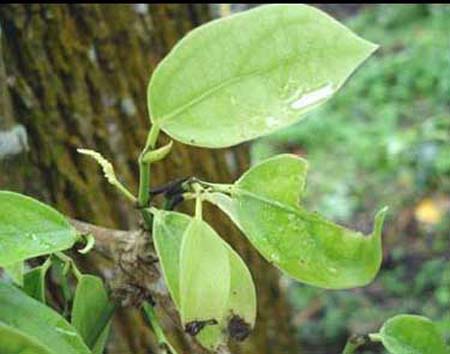
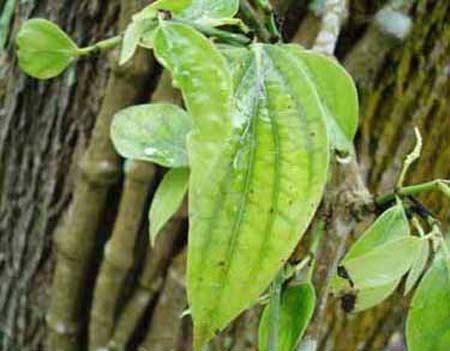
Black Pepper (Piper nigrum)
Nitrogen (N)
Symptoms
- Deficiency symptoms will be first noticed in older leaves.
- Initial symptom - Lower leaves become pale yellowish in colour
- Severe deficiency- entire plant show yellow to orange-yellow discolouration and leaf tip necrosis
- Leaf abscission
- Stunted growth of plants
- Yellowing, wilting and drying of leaves
Management
- For determining the severity of the deficiency, soil analysis has to be done
- Application of quick releasing nitrogen fertilizer like urea, according to the results of the soil test.
- Apply urea as a foliar spray (10 gram per litre of water) once every 15 days .
- Frequent application of organic growth boosters is also beneficial.
Phosphorus (P)
Symptoms
- Deficiency symptoms will be first noticed in older leaves.
- Dull looking, stiff and bronze coloured older leaves
- Leaf necrosis
- Withering and early death of leaves
- Stem become thinner
- Reduced lateral growth and secondary branching
- Reduced root growth
- Stunted root growth and lack of healthy roots
Management
- Ensure that recommended amount of fertilizer is applied on regular time.
- For determining the severity of the deficiency, soil analysis is to be done
- Use fertilizers such as single superphosphate for quick correction or bone meal or rock phosphate for long-term correction.
- In the pH range of 6.2-7.0, phosphorus is readily absorbed by the roots.
- Addition of biofertilizers including phosphorus solubilizing bacteria along with organic manure helps to increase the availability of phosphorus
Potassium (K)
Symptoms
- Deficiency symptoms will be first noticed in older leaves
- Brittle and grey coloured leaves
- Bronzing of leaves
- Necrosis of leaf along the veins
- 'V' shape yellow to reddish brown band on leaves
- Tip burn symptom on leaf
- Reduced growth
- Premature leaf fall
Management
- In the pH range of above 6, Potassium is readily available.
- Maintain pH by addition of lime/dolomite
- Improve the soil fertility by adding organic matter and wood ash.
- For determining the severity of the deficiency, soil analysis is to be done
- Use Muriate of Potash (MOP) according to the results of the soil test. Split application is preferable.
- Apply foliar sprays of sulphate of potash (SOP) (10 gm/liter of water) and wetting agents in the morning as an immediate remedy
Calcium (Ca)
Symptoms
- Calcium deficiency is first observed in fresh mature leaves
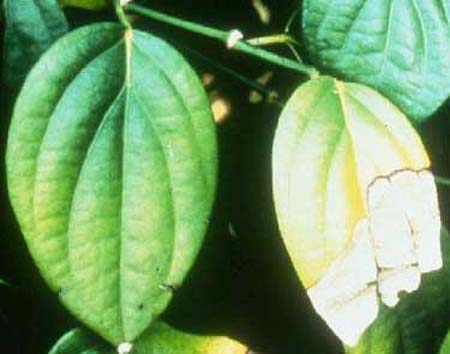
- Yellowing or chlorosis of leaf
- Marginal chlorosis and necrosis of the leaves
- Tiny pinhead necrotic spots between the main veins on the lower and upper surfaces of the leaves
- Premature leaf abscission
- Die-back of growing point.
- Short internodes with leathery leaves
Management
- Analysis of pH in the soil
- If the soil is acidic (3.5-4.5) , add 3.4 kg of lime per cent in two split doses
- In the areas of moderate acidity (pH between 5.5-6 apply 1 kg lime per cent).
- High phosphorus levels leads to calcium deficiency
- In alkaline soil application of Gypsum is preferable
Magnesium (Mg)
Symptoms
- Symptoms first appear on older leaves
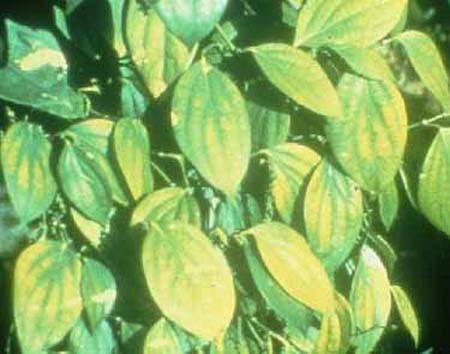
- Interveinal chlorosis of leaves
- Necrotic lesions develop within the chlorotic areas.
- Premature leaf falling of older leaves leads to bare stem
- Area near petiole remain green gives arrowhead appearance on leaves
Management
- Do the soil analysis and confirm the deficiency.
- Addition of Magnesium sulphate (320 gram /cent or 32 kg/ acre) in bands near plants.
- Long-term usage of dolomite will reduce magnesium deficiency
- Magnesium and potassium fertilizers should not be applied together.
Boron (B)
Symptoms
- Deficiency is seen mainly in younger leaves
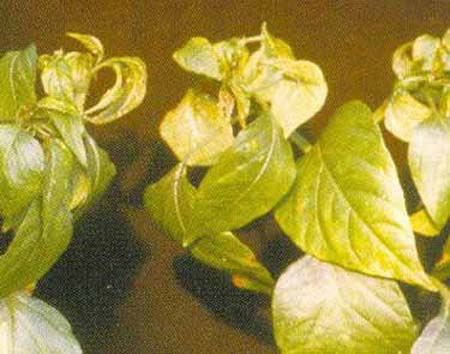
- Young leaves become small and malformed
- Puckering and necrosis on the main vein
- Reduced branching
- Shortened internodes
- Stunted growth of plants
- Reduced size of berry
Management
- Analysis of soil to confirm the deficiency.
- Application of borax (40 gram /cent or 4 kg/ acre) into the soil
- Addition of borax (1 gram / liter of water) as foliar spray .
- Avoid the combined application of Boron and calcium.
- Application of borax with ammonium fertilizers should be avoided.
Iron (Fe)
Symptoms
- Deficiency symptoms first appear on young leaves
- Interveinal chlorosis with green band along the veins
- Leaf necrosis
- Shortened internodal length
- Reduced lateral branching
- Reduced size of leaves and resetting
- Berries become pale green to yellow in colour
- Premature leaf fall
Management
- Iron content in Kerala soils is often high. So, get a soil test to determine the reason for the problem
- Low potassium levels leads to iron deficiency
- Addition of Ferrous Sulphate (60 gram/cent or 6 kg/ acre) into the deficient soils.
Manganese (Mn)
Symptoms
- Deficiency symptoms first appear on those leaves just reaching their full size
- Interveinal chlorosis of young leaves
- older leaves show herring bone pattern with green veins and yellowish white interveinal area
- Necrotic spots on the leaf
- Abscission of affected leaves
- growth retardation of plants
Management
- Soil Analysis
- Application of Manganese Sulphate (5 gram per litre of water) as foliar spray