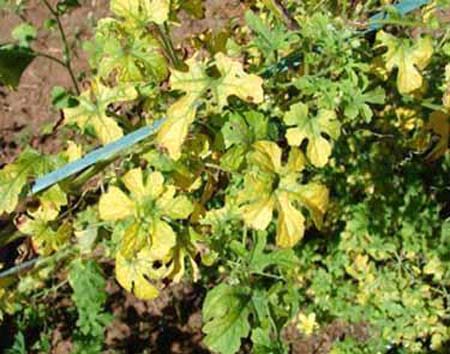
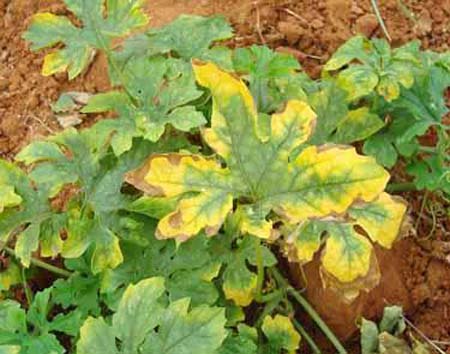
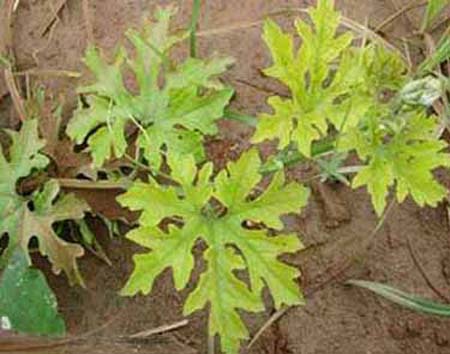
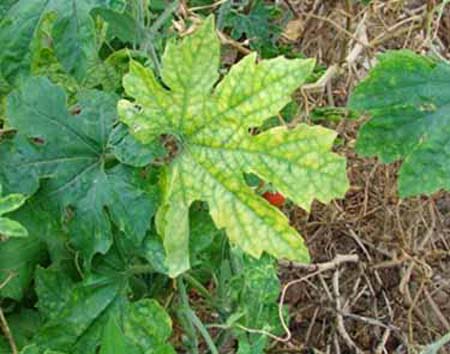
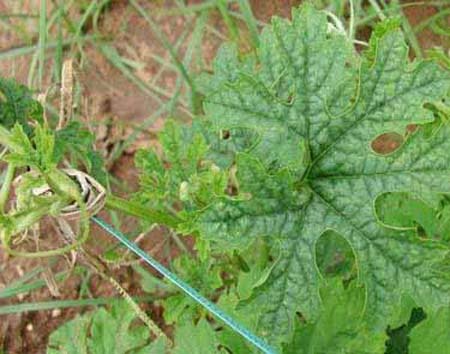
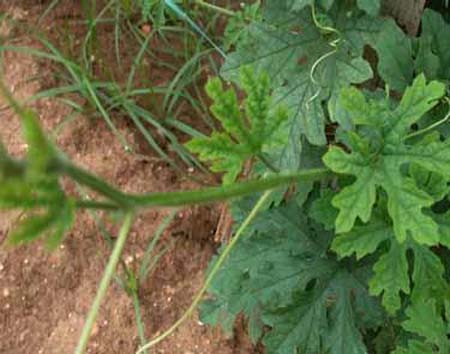
Deficiency symptoms will be first noticed in older leaves.
Pale green to light green colour change on leaves
Death and / or dropping of the older leaves
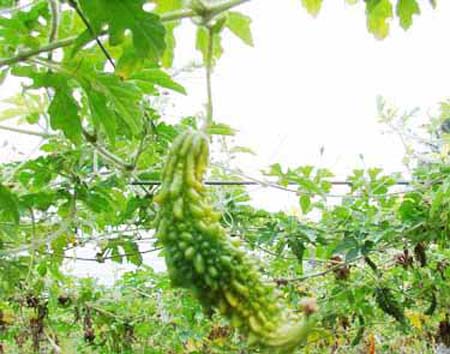
Pale, small and thick fruits
Malformed fruits and reduced yield
The yellowing spreads up the shoot to younger leaves.
Pale green to light green colour change on leaves.
Colour change normally starts from the leaf tip
Stunted growth
Management
For determining the severity of the deficiency, soil analysis has to be done
Application of quick releasing nitrogen fertilizer like urea, according to the results of the soil test.
Apply urea as a foliar spray (10 gram per litre of water) once every 15 days
Frequent application of organic growth boosters is also beneficial
Phosphorus (P)
Symptoms
Deficiency symptoms will be first noticed in older leaves
purpling of the leaves, particularly the leaf veins.
Short and thin shoots
Lose vigor and poor yield
small, stiff and dark green younger leaves
Shriveling of leaves
Leaves are dull (lacking lustre)
Management
Ensure that recommended amount of fertilizer is applied on regular time.
For determining the severity of the deficiency, soil analysis is to be done
Use fertilizers such as single superphosphate for quick correction or bone meal or rock phosphate for long-term correction.
In the pH range of 6.2-7.0, phosphorus is readily absorbed by the roots.
Addition of biofertilizers including phosphorus solubilizing bacteria along with organic manure helps to increase the availability of phosphorus
Potassium (K)
Symptoms
Deficiency symptoms will be first noticed in older leaves
Yellowing and scorching of older leaves
Cupping or “puckering” of leaves
Sunken necrotic spots along the midrib
A brown scorch develops in the yellow areas and spreads until the leaf is dry and papery
Abnormal flesh texture and off flavor of melons
Brown or spotted appearance of melons
Upward curling of leaves
Leaves are dull (lacking lustre)
shoot die-back
Stunted growth and weak stems
Decreased number of female flowers
Management
In the pH range of above 6, potassium is readily available.
Maintain pH by addition of lime/dolomite
Improve the soil fertility by adding organic matter and wood ash.
For determining the severity of the deficiency, soil analysis is to be done
Use Muriate of Potash (MOP) according to the results of the soil test. Split application is preferable.
Apply foliar sprays of Sulphate of Potash (SOP) (10 g/litre of water) and wetting agents in the morning as an immediate remedy
Calcium (Ca)
Symptoms
Deficiency symptoms will be first noticed in younger leaves
Yellow stripes parallel to leaf midrib and crinkling of leaves.
Marginal chlorosis
Abnormal leaf shapes
Scorched and distorted leaves
Stunted growth of plants
Leaf margins have failed to expand fully
Upward curling of leaves
Short internodes with resetting of leaves
Leathery and brittle leaves
Hooked tips and curled margins of new leaves
Die back of growing regions
Smaller and tasteless or may fail to develop fruits
stunted, translucent, and bulbous roots with dead tips
Management
Do the soil analysis
Check the pH of the soil. If the soil is extremely acidic (pH between 3.5 and 4.5), apply lime (3.4 kg/cent in two split doses). And in areas of moderate acidity (pH between 5.5 and 6), apply lime 1 kg/cent.
High phosphorus levels lead to calcium deficiency.
In alkaline soil application of Gypsum is preferable
Boron is needed for calcium utilization.
So, a boron deficiency can also lead to calcium deficiency.
Magnesium (Mg)
Symptoms
Symptoms first appear on those leaves just reaching their full size
Yellowing in the middle of the leaf blade with green margins
Chlorotic leaves turn red and develop spotted necrosis
Interveinal chlorosis
Premature leaf abscission
Reduced fruit yield
shriveling and dropping of older leaves
Tan burn in the yellow regions
Spotted necrosis of leaves
Management
Do the soil analysis and confirm the deficiency.
Addition of Magnesium sulphate (32 kg/ acre) in bands near plants.
Long-term usage of dolomite will reduce magnesium deficiency
Magnesium and potassium fertilizers should not be applied together
Sulphur(S)
Symptoms
Deficiency symptoms first appear in younger leaves.
Chlorosis followed by general yellowing
Plant growth is restricted
Leaves remain small, particularly the younger ones
Downward curling of leaves
Management
Application of sulphur-containing fertilisers, such as Factamfos, Ammonium sulphate, Single superphosphate, etc., reduces the deficiency.
In sulphur deficient soils, apply sulphur dust (10 kg/acre).
Deficiency in alkaline soil can be reduced by application of gypsum
Addition of organic material improves sulphur availability in the soil
Burning of organic waste leads to sulphur deficiency
Boron (B)
Symptoms
Deficiency is seen mainly in younger leaves
Malformed newly emerging leaves
Stunted growth.
Bushy plant habit due to death of all buds
Young fruit die or abort in large numbers
mottled yellow longitudinal streaks on fruits
corky marking (scurfing) along the skin of fruits size
Reduction in weight and size of the fruit.
Cracking of fruits and fruit fall
Management
Analysis of soil to confirm the deficiency.
Application of borax (4 kg/ acre) into the soil
Addition of borax (1 gram / litre of water) as foliar spray
Avoid the combined application of Boron and calcium.
Application of borax with ammonium fertilizers should be avoided.
Iron (Fe)
Symptoms
Deficiency symptoms first appear on young leaves
Interveinal chlorosis with eventual bleaching of the new growth
Yellow leaves with dark green veins
Entire plant become light green in colour
Stunted growth
Veins remain green, which gives a net-like pattern
Vein clearing results in a faint green network( skeleton) on leaf
Management
Iron content in Kerala soils is often high. So, get a soil test to determine the reason for the problem
Low potassium levels lead to iron deficiency
Addition of Ferrous Sulphate (6 kg/ acre) into the deficient soils.
Manganese (Mn)
Symptoms
Deficiency symptoms first appear on those leaves just reaching their full size
Interveinal mottled chlorosis
Small necrotic lesions in chlorotic areas
Fine network of green veins in a light green background on leaves
Reduced leave size
Crimpled leaf margins
Management
Soil Analysis
Application of Manganese Sulphate (2 gram per litre of water) as foliar spray
Zinc (Zn)
Symptoms
deficiency symptoms first appear on young leaves
interveinal chlorosis with an eventual whiting
Leaves pale green in colour and with green veins.
Reduced leaf area
Shortening of internodes
Distorted and rosette forms of leaves
Management
The optimal pH range for zinc availability is 5 to 7.5.
Confirm deficiencies by doing soil testing.
Apply zinc sulphate to deficient soils (8 kg/ acre)
Avoid the application of zinc and phosphate fertilizers at the same time
In severe cases, foliar spraying of zinc sulphate (2 gram/litre of water) with Calcium carbonate (2.5 gram/litre of water) can be advocated in morning hours.
Molybdenum (Mo)
Symptoms
Distorted leaves with reduced leaf area
Interveinal chlorosis with dark green main veins
"Whiptail" formation
chlorotic leaf margins
In severe cases the whole leaf turns yellowish
Management
Soil application of 1.0 kg sodium molybdate /ha
Foliar spray of sodium molybdate 0.1%
Soil application of 120kg N, 75 kg P and Mo 1.5kg/ha, 1 kg B/ha