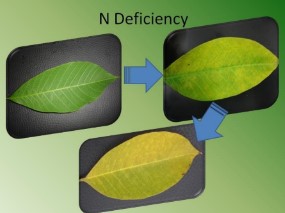
Initially whole leaf becomes pale yellow-green in colour & later turns into yellow.
Symptoms will first appear on the older leaves in the lower storeys, and in severe cases deficiency affect the upper and younger storeys on the tree.
Reduced the size of the crop canopy: retardation & express stunted in growth.
The deficiency symptoms are more prominent on leaves exposed to full sunlight than on leaves in the shade of the canopy.
Management
For determining the severity of the deficiency, soil analysis has to be done
Application of quick releasing nitrogen fertilizer like urea, according to the results of the soil test.
Apply urea as a foliar spray (10 gram per litre of water) once every 15 days .
Frequent application of organic growth boosters is also beneficial.
Phosphorus (P)
Symptoms
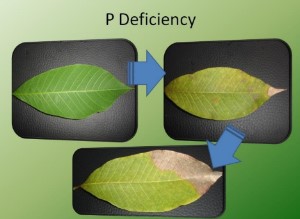
Bronzing of part of the under surface of the leaf not clearly evident on inspection of the upper surface of the leaf.
The bronzing is often largely restricted to one half of the leaf, and is usually first seen at the distal end of the lamina; the leaf tip frequently dies back.
The symptoms are usually first found on leaves in the middle and upper storeys, and considerable defoliation can occur.
Leaves become small.
Management
Ensure that recommended amount of fertilizer is applied on regular time.
For determining the severity of the deficiency, soil analysis is to be done
Use fertilizers such as single superphosphate for quick correction or bone meal or rock phosphate for long-term correction.
In the pH range of 6.5-7.5, phosphorus is readily absorbed by the roots.
Addition of biofertilizers including phosphorus solubilizing bacteria along with organic manure helps to increase the availability of phosphorus
Potassium (K)
Symptoms
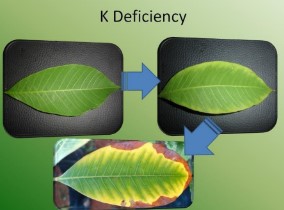
The characteristic symptom of potassium deficiency is the development of marginal and tip chlorosis which is followed by marginal necrosis.
Only older leaves exhibit the deficiency symptoms.
Size reduction of the leaves
The symptoms usually appear on the leaves in the lower or older storeys on the plant.
Deficient in plants produces interveinal chlorosis followed by necrosis
Affected plants shortened petioles & stems and may develop terminal bud death
Management
In the pH range of above 6, Potassium is readily available.
Maintain pH by addition of lime/dolomite
Improve the soil fertility by adding organic matter and wood ash.
For determining the severity of the deficiency, soil analysis is to be done
Use Muriate of Potash (MOP) according to the results of the soil test. Split application is preferable.
Apply foliar sprays of sulphate of potash (SOP) (10 gm/litre of water) and wetting agents in the morning as an immediate remedy
Calcium (Ca)
Symptoms
No prominent yellowing of the leaf.
Marginal scorch is noticed as usually white to light brown in colour, often over a large portion of the leaf as in the most affected leaves.
The symptoms are observed on the leaves on the upper or younger storeys on the plant, and in severe cases the growing point itself may die back.
There can be considerable reduction in leaf size.
The leaves become leathery and brittle.
Management
Analysis of pH in the soil
If the soil is acidic, add 500 g of lime per plant/year in two split doses
High phosphorus levels leads to calcium deficiency
In alkaline soil application of Gypsum is preferable
Magnesium (Mg)
Symptoms
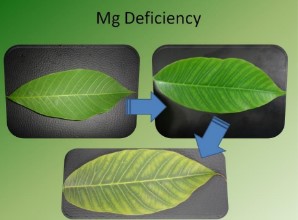
The symptoms are first to be found on the leaves in the lower or older storeys on the plant
Development of chlorosis in the interveinal areas on the leaf.
Generally, the chlorosis appears to spread inwards from the leaf margins.
In young seedlings or buddings a few months old it is sometimes found that the chlorotic areas are not contiguous with the leaf margin.
Only little reduction in leaf size, although when the deficiency is extremely severe there can be considerable defoliation and marked reduction in tree growth and leaf size.
Management
Do the soil analysis and confirm the deficiency.
Addition of Magnesium sulphate (32 kg/ acre) in bands near plants.
Long-term usage of dolomite will reduce magnesium deficiency
Magnesium and potassium fertilizers should not be applied together.
Sulphur(S)
Symptoms
The symptom will be found first on leaves in the upper, younger storeys
Gradual uniform yellowing of leaf
Entire leaf may turn yellowish in colour, reduced size, typical necrotic spots at the tip of the leaf & sometimes all over the surface
Leaves of young shoots are firstly affected
Deficient plants show cupping of leaves & later affects whole distal end of leaf.
Management
Application of sulphur-containing fertilisers, such as Factamfos, Ammonium sulphate, Single superphosphate, etc., reduces the deficiency.
In sulphur deficient soils , apply sulphur dust (50 gram per plant or 10 kilogrammes per acre).
Deficiency in alkaline soil can be reduced by application of gypsum
Addition of organic material improves sulphur availability.in the soil .
Burning of organic waste leads to sulphur deficiency
Boron (B)
Symptoms
Leaf formation of immature leaves
Necrosis of terminal bud
Stunted plant growth
Young leaves show transverse split with exudate latex
Deficiency is found in the younger, upper storeys on the plant, which will not be separated by any discrete internode.
In Boron deficient trees individual storeys cannot be distinguished & continuous production of leaves gives the stem an appearance of 'bottle-brush
In severe cases, the plant exhibit the death of apical meristem & development of axillary meristems near the top of the stem.
No loss of colour on leaves and veins appear to be wider than normal
Management
Analysis of soil to confirm the deficiency.
Application of borax (20 gram /plant or 4 kg/ acre) into the soil
Addition of borax (1 gram / litre of water) as foliar spray .
Avoid the combined application of Boron and calcium.
Application of borax with ammonium fertilizers should be avoided.
Copper (Cu)
Symptoms
Symptoms are first observed on the youngest leaves.
Copper deficiency causes severe distortion & stunting of leaf growth.
Wilting of the leaf margin at the tip, with subsequent upward cupping of the leaf tip.
Wilting of the margin develops into a very pale brown scorch spreading down the lamina from the tip; leads to shedding of lamina.
Frequently shedding of leaves bare stem.
Such defoliation results in death of apical growing point which inturn produce new shoots from axillary meristem results in multiple branching:
In extreme deficiency, leaf cupping, scorching & abscission of leaf leads to death of the apical meristem.
Management
Apply copper sulphate ( 4 gram /plant or 800 gram/acre) in the soil
Iron (Fe)
Symptoms
The deficiency symptoms are found on the younger leaves in terminal whorls exposed to full sunlight.
General leaf chlorosis
With increase in severity entire leaf assumes a pale lemon yellow to white colour.
Considerable reduction in leaf size.
Management
Iron content in Kerala soils is often high. So, get a soil test to determine the reason for the problem
Low potassium levels leads to iron deficiency
Addition of Ferrous Sulphate (30 gram/plant or 6 kg/ acre) into the deficient soils.
Manganese (Mn)
Symptoms
Symptoms are more often observed on the large leaves tree than on the small leaves.
Paling and yellowing of the leaf is typical symptom
The mid rib and main veins are seen as bands which are more evident when deficiency is severe.
No necrosis of leaf tip or margin occurs.
Little reduction in leaf size are more prominent occurs even when the deficiency is severe
Management
Soil Analysis
Application of Manganese Sulphate (5 gram per litre of water) as foliar spray
Zinc (Zn)
Symptoms
Deficiency mostly seen in young rubber plants either in the nursery or in the field.
Deficiency causes Interveinal chlorosis of leaves.
Leaves become reduced in size in both breadth & length.
Young leaflet shows hooked or claw appearance.
Lamina may become twisted and the margins appear wavy or undulating.
In severe conditions death of the apical meristem occurs & shoots are developed from axillary meristems.
Management
The optimal pH range for zinc availability is 5 to 7.5.
Confirm deficiencies by doing soil testing.
Apply zinc sulphate to deficient soils (40 g /plant or 8 kg/ acre)
Avoid the application of Zinc and phosphate fertilizers at the same time
In severe cases, foliar spraying of Zinc sulphate (2 gram/litre of water) with Calcium carbonate (2.5 gram/litre of water) can be advocated in morning hours.