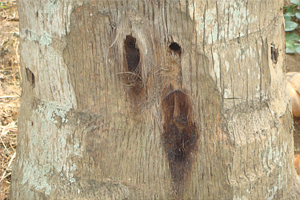
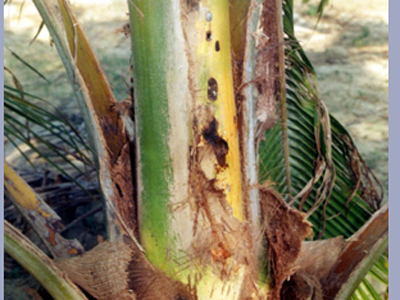
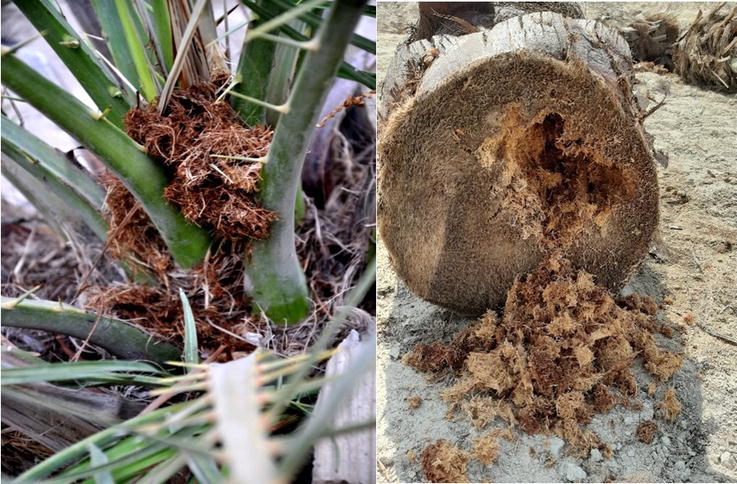
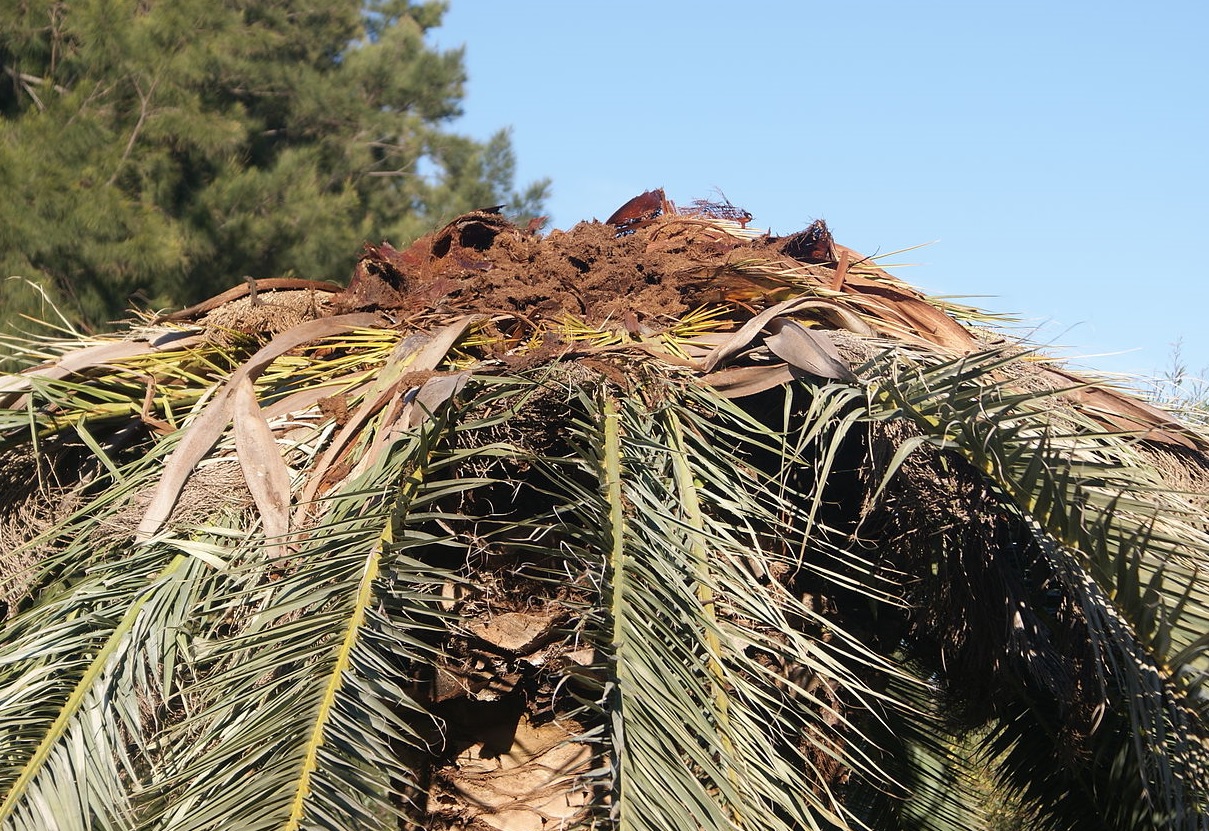
The diagnostic symptoms are the presence of holes on the stem, oozing out of a viscous brown fluid and extrusion of chewed up fibrous matter through the hole, longitudinal splitting of leaf base and wilting of central shoot.
Sometimes the gnawing sound produced by the feeding grubs inside will also be audible.
Management
Field sanitation should be given prime importance.
Avoid making steps or any other injury on the tree trunks to reduce the loci of infestation.
When green leaves are cut from the palms, stumps of not less than 120 cm may be left on the trees in order to prevent successful inward movement of the grubs through the cut end.
Coconut log traps with fermenting toddy or pineapple or sugarcane activated with yeast or molasses can be set in coconut plantation to attract and trap the free floating population of red palm weevil. Incorporate any of the insecticide to each trap to kill the weevils trapped.
Use of pheromone trap for attracting and killing adult weevils @ one trap per 2 ha.
Aggregation pheromone [4 methyl 5 nonanol (9 parts): 4 methyl 5-nonanone (1 part)] embedded in nanomatrix @ one trap /ha preferably can be used for mass entrapping the floating weevil population. It consists of a plastic bucket of 5 litre capacity with four windows (5 x 1.5 cm) below the rim of the bucket. The commercially available pheromone lure is hung inside on the lid of the bucket. The bucket is hung on a pole at 1.5 m height along the field boundary. The efficiency of pheromone trap can be enhan- ced by placing 100 g pine apple/sugarcane/ banana, 2 g yeast in one litre of water which works as the kairomone. The food bait has to be replaced once in 15 days for good weevil catch and to avoid slippages.