

Rice (Oryza sativa)
Rice Blast( Pyricularia grisea )
Symptoms
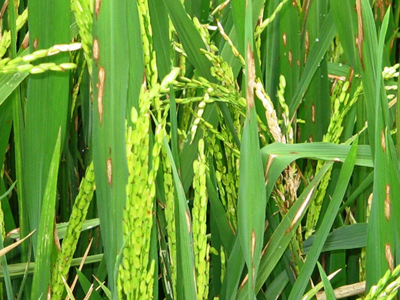
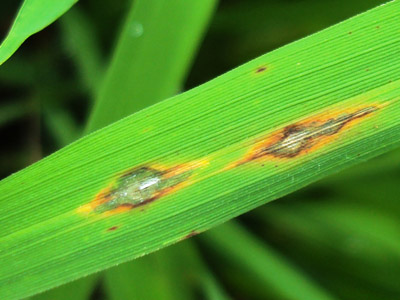
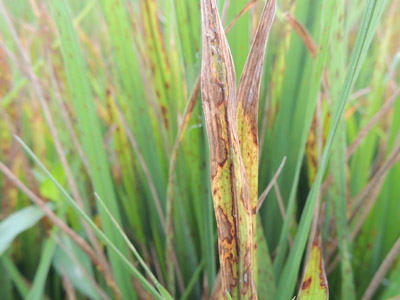
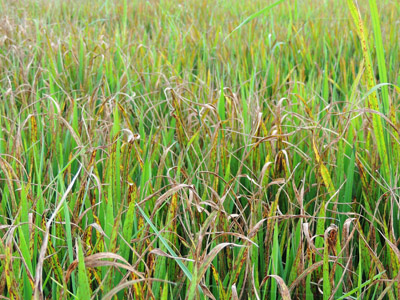
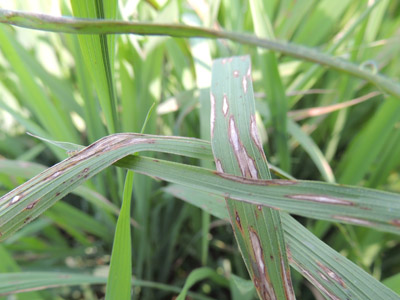
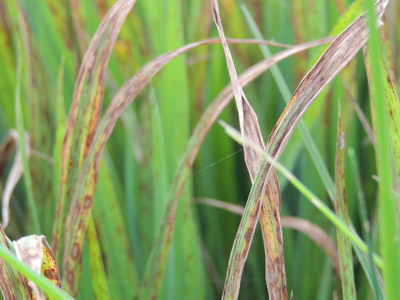
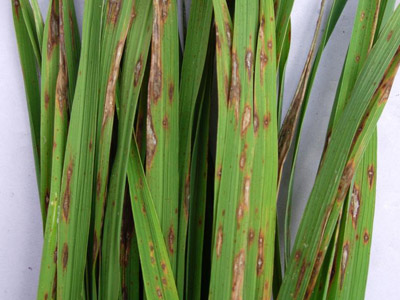
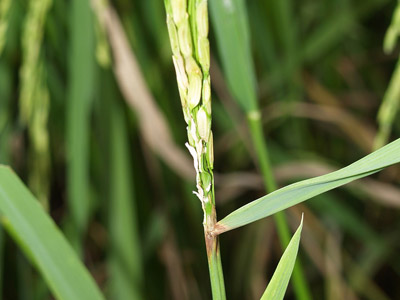
- Noticed generally on leaves, nodes, panicles and grains, and rarely on leaf sheath.
- Leaf blast:- Symptoms appear as minute brown specks at first,which enlarge to form spindle shaped lesions with pointed ends in susceptible cultivars.
- The centre of the spot is grey or white with brown or reddish brown margin and with conspicuous yellow halo around the spots.
- Fully developed lesions are 1 to 1.5 cm in length and 0.3 to 0.5 cm in width. However, in resistant cultivars only minute brown pinheads are noticed.
- Heavily infected leaves soon become blighted and die.
- Nursery blast:- Severe infection in the nursery stage causes death of seedlings.
- Badly affected nurseries can be recognized from a distance by their brownish, scorched appearance.
- Node blast:- When infection occurs on nodes it rots leading to death of the parts above the node.
- The most destructive phase of the disease is when the pathogen infects panicles.
- Neck blast:- The symptom is characterized by the appearance of black or grayish brown lesions at the base of the panicle(neck).
- If the symptoms occur at the time of panicle emergence, entire grains of the panicle turn chaffy.
- The attack at later stages,causes partly filled grains.
- Brown to black spots is also sometimes seen on the infected glumes.
Management
- Use certified and healthy seeds. Kanchana, Makom, Onam, Swarnaprabha, Athira, Aiswarya, Jaya, IR-8 etc. are resistant varieties.
- Remove and destory the weed hosts in the field bunds and channels.
- Avoid excess use of nitrogenous fertilizers.
- Seed treatment with Pseudomonas fluorescens (10 g/litre of water for 1 kg of seed), seedling dipping in and prophylatic spraying of Pseudomonas fluorescens (20 g/litre of water) is effective in preventing the incidence of the disease.
- Soak seed for 12 to 16 hours in Carbendazim 50 WP (2 gram / kg of seed per litre of water).
Chemical Control
| Sl.No | Generic Name | Trade Name | Color code | Dosage/litre | Knapsack Sprayer (Capacity 10L) | Dosage/acre (200 L) | Dosage/hectare (500 L) | Remarks |
|---|---|---|---|---|---|---|---|---|
| 1 | Carbendazim 50 WP | Bavistin, Benfil, Bengard, Benlate, Benmain, Bensaan, Carben, Carziim50, Dhanustin, Dhanustin 50 WP, Fungiguard, Gancarzin50, Glizim, Mintho, Tagstin, Tiara, Zoom | Green | 1 g/ litre of water | 10 g | 200 g | 500 g | |
| 2 | Carpropamid 27.8 SC | Arcado , Protega | Green | 1 ml/ litre of water | 10 ml | 200 ml | 500 ml | |
| 3 | Isoprothiolane 40 EC | Fuji-one 40 E, Isomain, Rhizo M-45 Manzate, Luzen-45, Macoban, Macoban M-45, Mancosaan, Mancosaan M-45, Maneb Manzane, M-Guard, Savour M 45, Tata M-45 Eurofil-NT, Uthane M-45, Veera, Zinthane | Blue | 1 ml/ litre of water | 10 ml | 200 ml | 750 ml | |
| 4 | Tebuconazole 25.9 EC | Folicur, Orius, Tebustar | Blue | 1-1.5 ml/ litre of water | 10-15 ml | 200-300 ml | 500-750 ml | |
| 5 | Hexaconazole 5 EC | Alert Creeper, Contaf, Corazole, Danzole, Force 5C, Hexaan, Hexacone, Hexadhan, Hexamax, Hexan, Hexazole, Mainex EC, Sitara, Strike, Titan, Topper, Topper plus EC, Xantho | Blue | 1 ml/ litre of water | 10 ml | 200 ml | 500 ml |
Extremely Toxic

Highly Toxic

Moderately Toxic