

Rice (Oryza sativa)
Weeds and Their Control
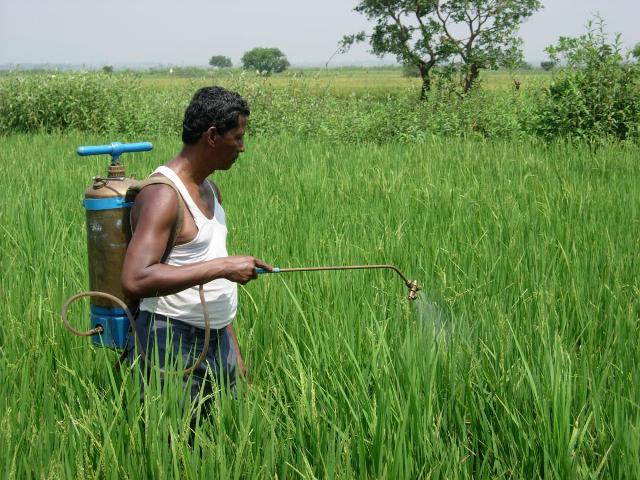
Common weeds in rice fields of Kerala are:
Grasses: Oryza rufipogon (varinellu),Echinochloa crusgalli (kavada) , E. colona (kavada) ,E. stagnina (kavada,) Saccolepis interrupta (polla) , Isachne miliacea (chovverippullu, naringa).
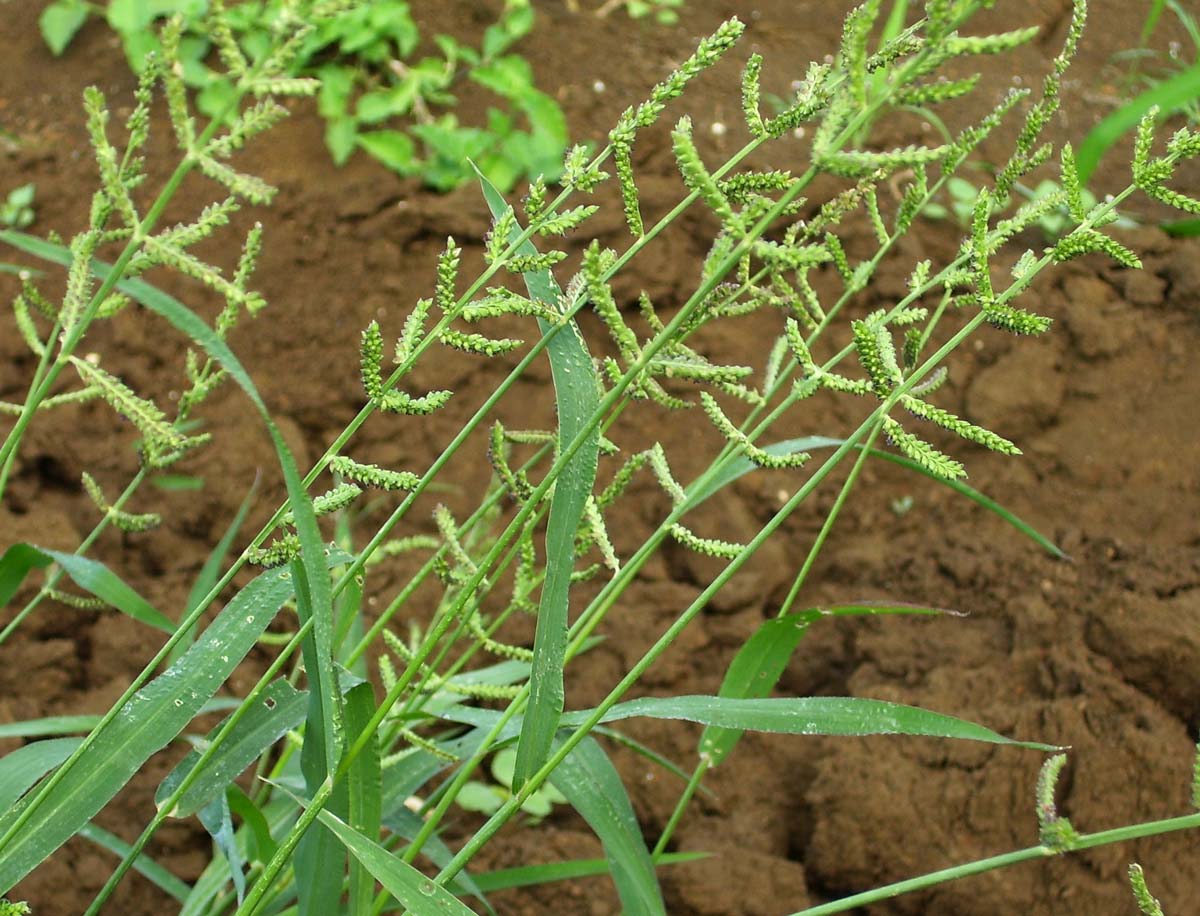
Echinochloa colona
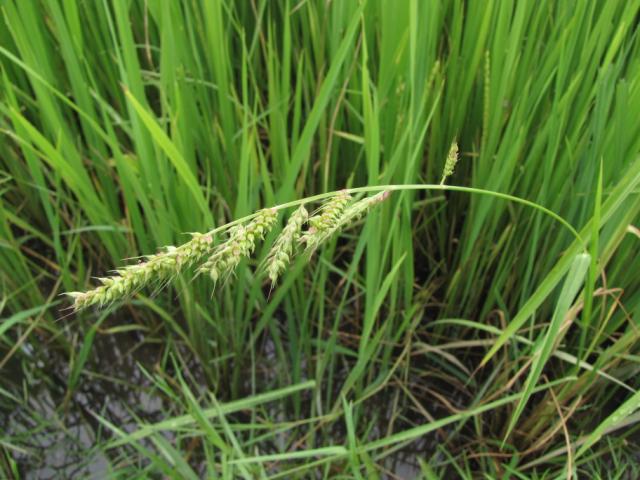
Echinochloa crusgalli
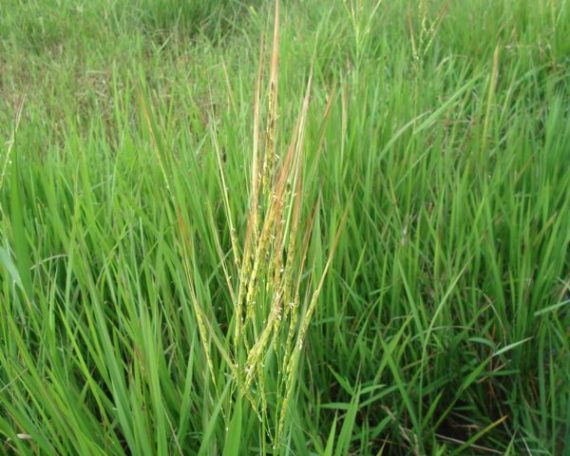
Oryza rufipogon
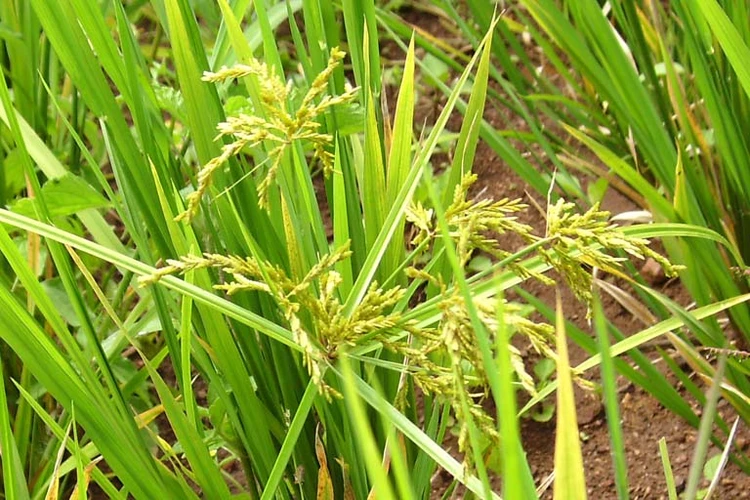
Cyperus iria
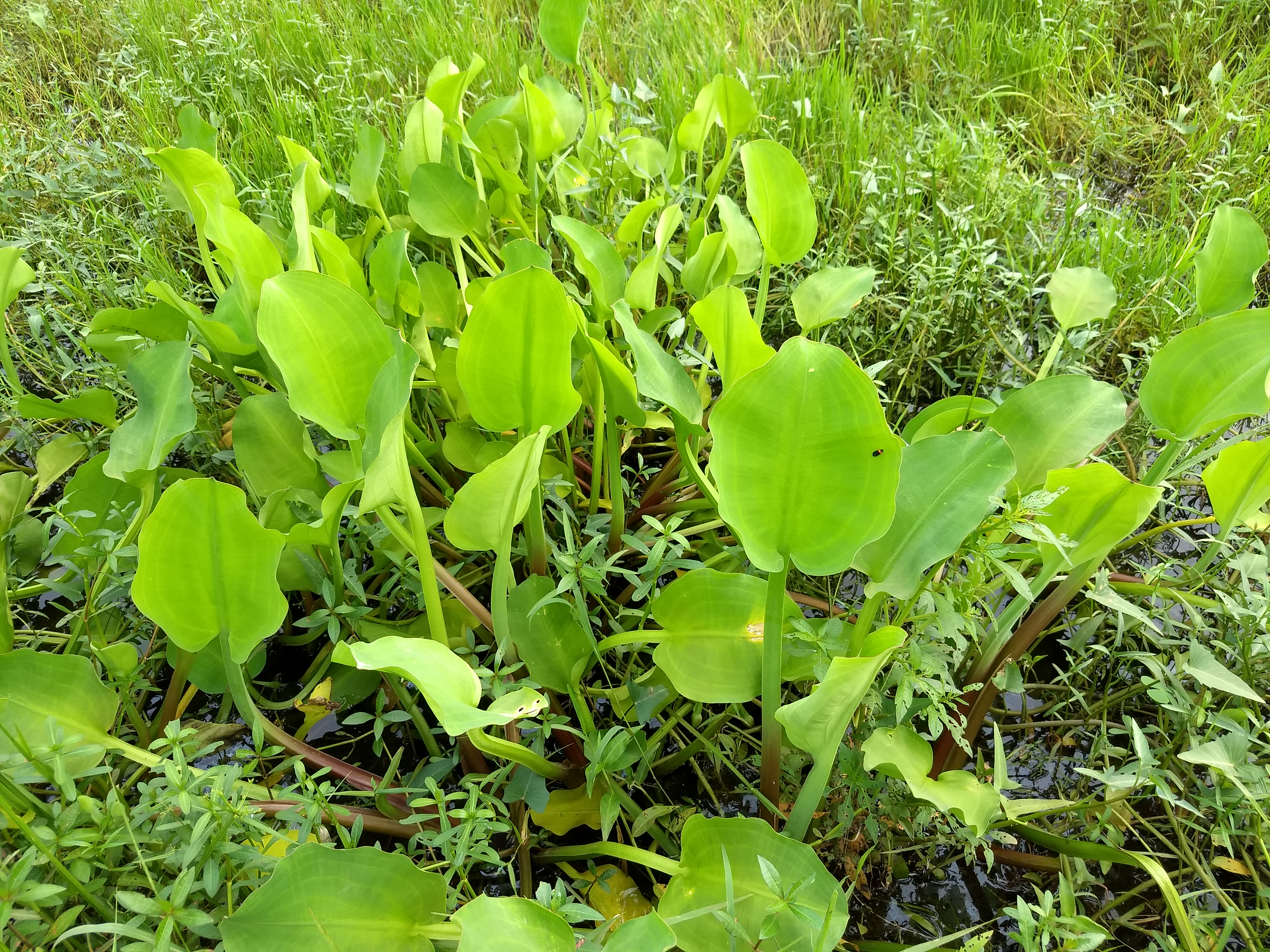
Limnocharis flava (nagappola)
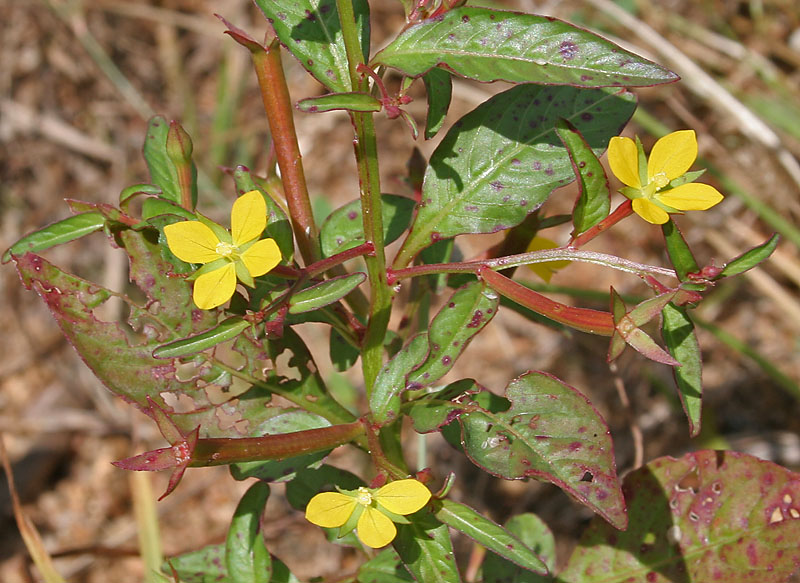
Ludwigia perennis (neergrampu)
Ferns: Salvinia molesta (African payal),Marsilea quadrifolia (naalilakodian,),Azolla pinnata (azola)
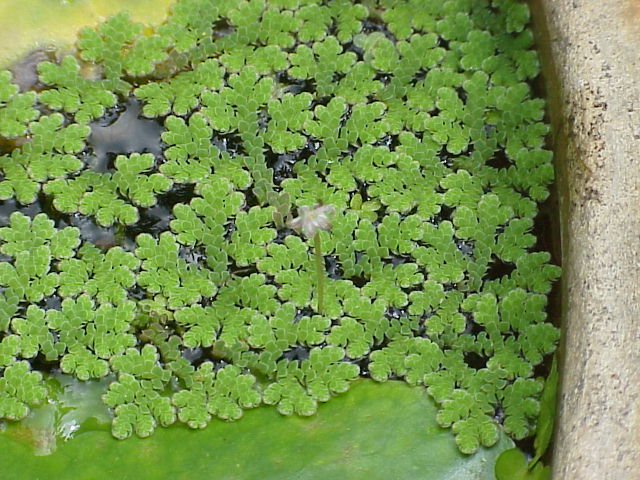
Azolla pinnata
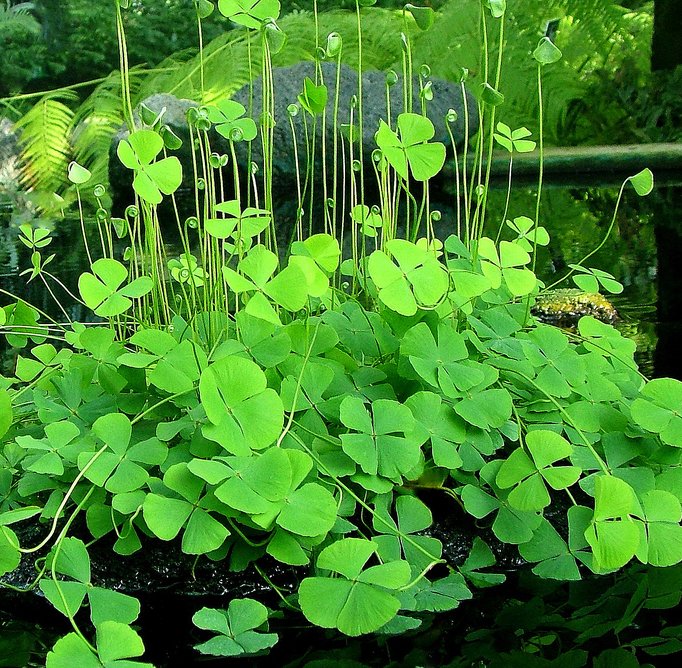
Marsilea quadrifolia
Control Measures
Keep the rice fields free from weeds up to 45 days either by hand weeding or by use of herbicides.
Management of weedy rice
Weed free seeds
Use seeds from weedy rice free areas.
Stale seed bed technique
After land preparation, withhold sowing and allow the weedy rice seeds in the top layers of the soil to germinate. After two weeks, when most of the seeds would have germinated, destroy the germinated seedlings by ploughing the field or by spraying non selective herbicides like glyphosate or glufosinate ammonium @ 8 ml product/litre of water. If time permits repeat the process once again. When the seedlings starts yellowing 4-5 days after herbicide application, let in water and flood the field to allow complete kill of the emerged seedlings. Drain the field after 10 days of flooding and broadcast the germinated rice seeds, without further ploughing. In fields with very severe infestation, skip the crop for one season and go for repeated stale seed bed operations to exhaust the soil seed bank of weedy rice.
Pre sowing herbicide application to prevent the establishment of weedy rice seedlings
After land preparation, drain the field to retain only a thin film of water. Apply oxyfluorfen @ 0.2 kg ai/ha either by spraying or sprinkling with a rose can or broadcasting after mixing with sand. Allow the water in the field to evaporate. After three to four days, when the standing water has evaporated, broadcast pre germinated rice seeds. The herbicide applied will prevent the emergence of weeds (including weedy rice) for about two weeks. Most of the rice seeds sown above this layer can germinate.
Direct contact application of herbicides to kill the earheads
Weedy rice produce earheads about 10-15 days ahead of rice. The quick growth just before flowering, results in about 15-30 cm height difference between rice and weedy rice. Utilizing this, non selective herbicides like glyphosate or glufosinate ammonium can be applied directly on to the earheads of weedy rice, using the KAU Weed Wiper specially designed for this purpose. Mix 100 ml of the herbicide (formulation of glyphosate or glufosinate ammonium) in one litre of water. Care should be taken not to apply the herbicide on the leaves of rice. The earheads of weedy rice will dry within 5 days.
The recommendation for the use of herbicides in different system of rice culture are given below.
I. Pre emergence herbicides
A. Dry seeded rice. [upland and lowland (semi-dry) rice]
| Sl.No | Herbicide | Dose (Kg ai/ha) | Time of Application | Weeds controlled | Remarks |
|---|---|---|---|---|---|
| 1 | Butachlor | 1.25 | 0 – 6 DAS | Pre emergence control of all types of weeds for 3 – 4 weeks. | Give a follow up hand weeding at 30 DAS or apply a post emergence herbicide, if needed, to control later emerging weeds. |
| 2 | Pretilachlor | 0.75 | 0 – 6 DAS | ||
| 3 | Oxyfluorfen | 0.15 | 0 – 6 DAS | ||
| 4 | Pendimethalin | 1.50 | 0 – 6 DAS | ||
| 5 | Pretilachlor + Bensulfuron methyl | 0.6 + 0.06 | 0 – 6 DAS |
B. Wet seeded rice. [Direct seeding with sprouted seeds under puddled conditions]
| Sl.No | Herbicide | Dose (Kg ai/ha) | Time of Application | Weeds controlled | Remarks |
|---|---|---|---|---|---|
| 1 | Butachlor | 1.25 | 6 – 9 DAS | Pre emergence control of all types of weeds for 3 – 4 weeks. | Give a follow up hand weeding at 30 DAS or apply a post emergence herbicide, if needed, to control later emerging weeds. Drain the field before herbicide application. Some phytotoxicity to rice seedlings likely. |
| 2 | Pretilachlor | 0.75 | 6 – 9 DAS | ||
| 3 | Oxyfluorfen | 0.15 | 6 – 9 DAS | ||
| 4 | Pretilachlor + safener (sofit) | 0.45 | 6 – 9 DAS | ||
| 5 | Pretilachlor + Bensulfuron methyl | 0.6 +0.06 | 6 – 9 DAS | ||
| 6 | Pyrazosulfuron ethyl | 0.02 – 0.03 | 6 – 9 DAS |
C. Transplanted Rice
| Sl.No | Herbicide | Dose (Kg ai/ha) | Time of Application | Weeds controlled | Remarks |
|---|---|---|---|---|---|
| 1 | Butachlor | 1.25 | 0-6 DAT | Pre emergence control of all types of weeds for 3 – 4 weeks. | Give a follow up hand weeding at 30 DAT or apply a post emergence herbicide, if needed, to control later emerging weeds. |
| 2 | Pretilachlor | 0.75 | 0-6 DAT | ||
| 3 | Pretilachlor + Bensulfuron methyl | 0.6 + 0.06 | 0-6 DAT | ||
| 4 | Pyrazosulfuron ethyl | 0.02 – 0.03 | 0-6 DAT | Maintain standing water in the field for good results |
II. Post emergence herbicides
A. Dicot weeds
| Sl.No | Herbicide | Dose (Kg ai/ha) | Time of Application | Weeds controlled | Remarks |
|---|---|---|---|---|---|
| 1 | 2,4- D | 0.80 | 20-25 DAS/DAT | Broad leaved weeds and sedges | Grass weeds not controlled |
| 2 | Chlorimuron ethyl + Metsulfuron methyl | 0.004 | 20-25 DAS/DAT | Broad leaved weeds and sedges. Control Marsilea quadrifolia and Sphehoclea spp also. |
with 0.2% surfactant |
| 3 | Carfentrazone | 0.02 | 20-25 DAS/DAT | Broad leaved weeds and sedges | Very effective against Melochia corchorifolia |
| 4 | Ethoxysulfuron | 0.015 | 20 DAS | Broad leaved weeds and sedges |
B. Grass weeds
| Sl.No | Herbicide | Dose (Kg ai/ha) | Time of Application | Weeds controlled | Remarks |
|---|---|---|---|---|---|
| 1 | Cyhalofop butyl | 0.08 | 15-18 DAS/DAT | Control grass weeds like Echinochloa spp, Sacciolepis spp, Leptochloa chinensis. | Broad leaved weeds and sedges are not controlled |
| 2 | Fenoxapropethyl | 0.06 | 15-18 DAS/DAT | Control grass weeds like Echinochloa spp, Sacciolepis spp, Leptochloa chinensis. | Broad leaved weeds and sedges are not controlled |
C. Broad Spectrum
| Sl.No | Herbicide | Dose (Kg ai/ha) | Time of Application | Weeds controlled | Remarks |
|---|---|---|---|---|---|
| 1 | Azimsulfuron | 0.035 | 15-20 DAS/DAT | All types of weeds | Only partial control of Leptochloa chinensis |
| 2 | Penoxsulam | 0.025 | 15-20 DAS/DAT | All types of weeds | Only partial control of Leptochloa chinensis |
| 3 | Bispyribac sodium | 0.025 | 15-20 DAS/DAT | All types of weeds except Leptochloa chinensis | Not effective against Leptochloa chinensis |
| 4 | Penoxsulam + cyhalofop butyl | 0.130 to 0.135 | 15-20 DAS/DAT | Wet sown and transplanted rice – all types of weeds except weedy rice | Recommended for all AEU’s |
*DAT = Days after Transplanting; DAS = Days after sowing
Management of Salvinia molesta (African payal)
Trampling salvinia in situ in the wet lands a week before transplanting will control the weed and add to soil fertility. Herbicides should be applied only in areas where protected drinking water supply is available.
Precaution while using herbicides
- Apply herbicides at the recommended dose and time.
- Drain the field before herbicide application.
- Re-flood after 48 hours to prevent further weed germination when post emergent herbicides are used. For pre-emergent herbicides, wait for a week before re-flooding the field.
- Use herbicide nozzle (flood jet / flat fan) for herbicide application.
- Move at uniform speed when applying herbicides.
- Spray without gaps and overlapping.
- Use 300-400 litres of water per hectare for spraying the herbicide.