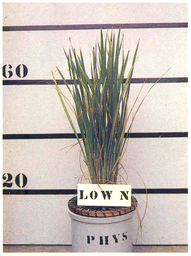
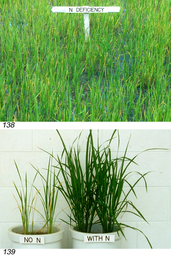
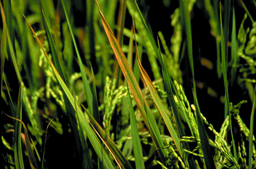
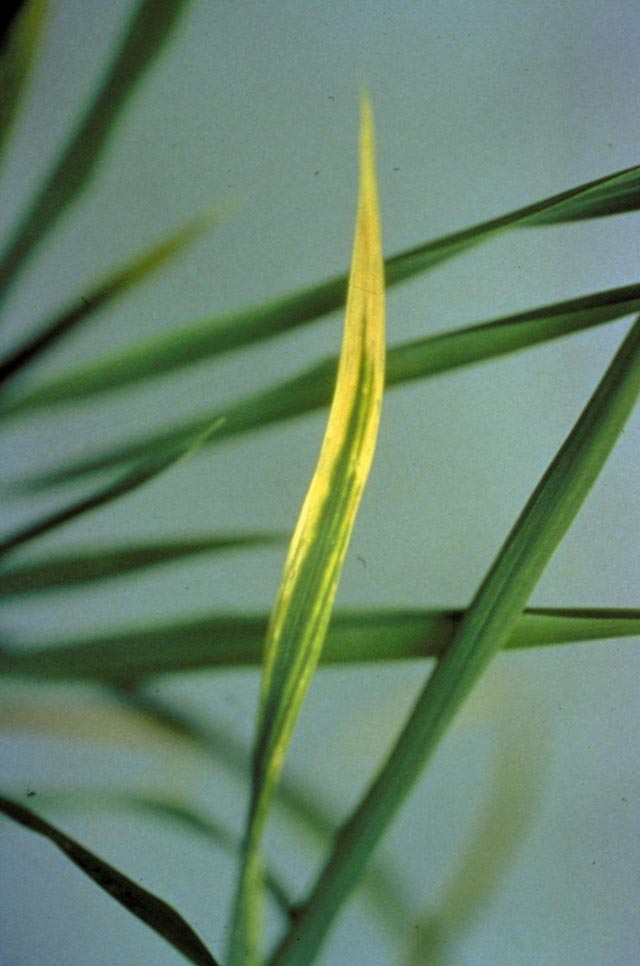
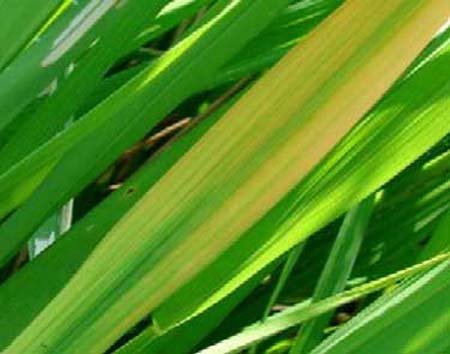
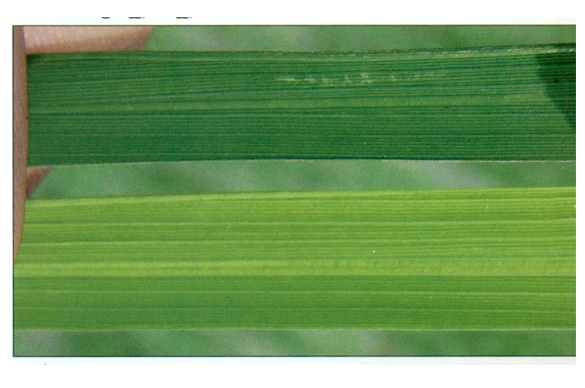
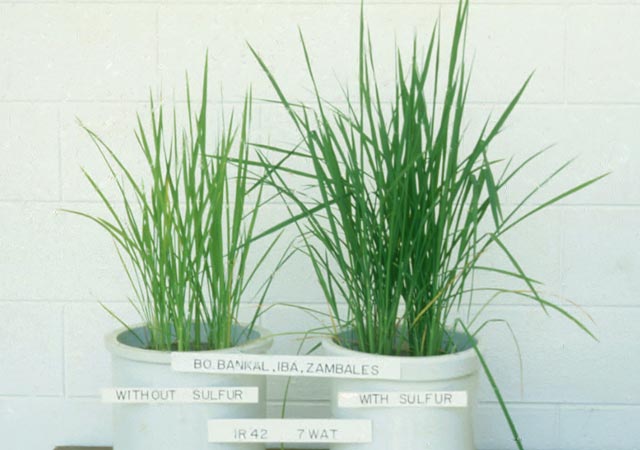
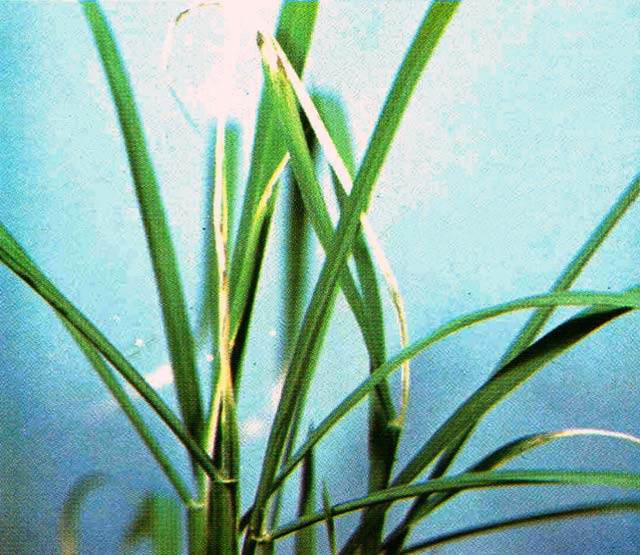
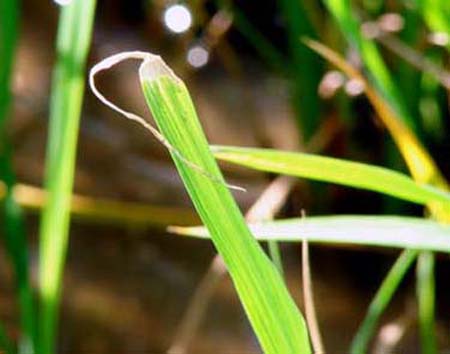
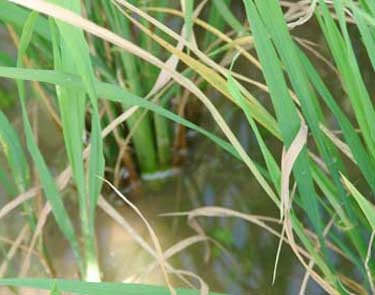
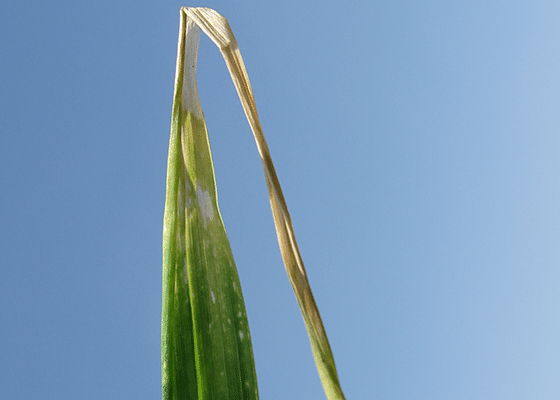
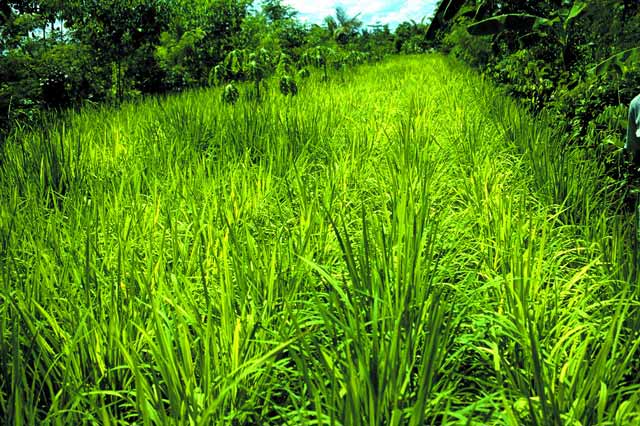
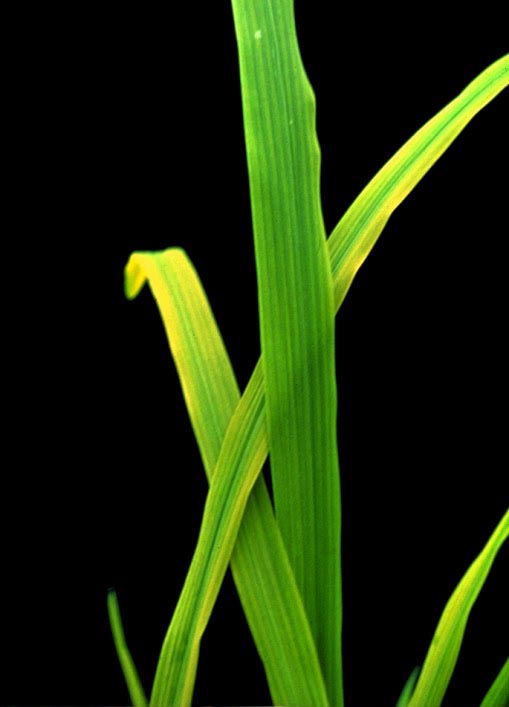
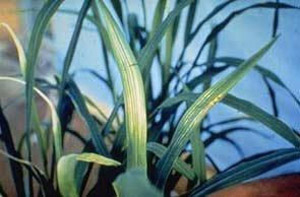
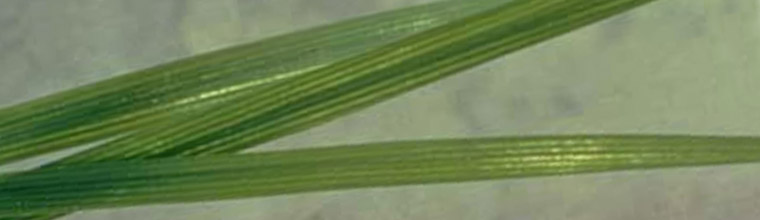
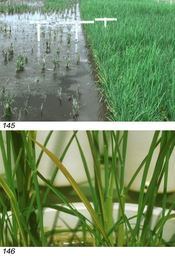
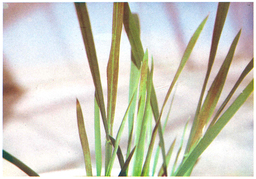
Symptoms occurs at critical growth stages such as tillering and panicle initiation
Yellowing first noticed on older leaves at the leaf tip and progresses along the midribs.
At advanced stages, leaves become narrow, short, erect and lemon-yellowish green in colour.
Some times all leaves become light green in colour and entire field may appear yellowish.
Stunted growth of plants are noticed.
Crop may loss under extreme deficiency
Management
For determining the severity of the deficiency, soil analysis has to be done
Application of quick releasing nitrogen fertilizer like urea, according to the results of the soil test.
Apply urea as a foliar spray (10 gram per litre of water) once every 15 days .
Addition of well rottened Farm yard Manure @10-15 kg/tree
Frequent application of organic growth boosters is also beneficial.
Phosphorus (P)
Symptoms
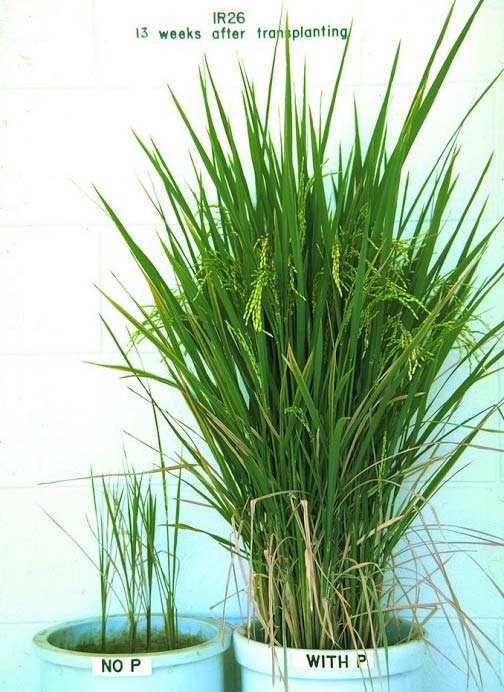
Symptoms will be first noticed in older leaves.
In some varieties of crop, red and purplish dicolouration may seen on leaves
Leaves become narrow short, very erect, and dark green in colour and older leaves turn brown and die
Poor root development results in stunted growth and reduced tillering with thin and spindly stems.
Management
Ensure that recommended amount of fertilizer is applied on regular time.
For determining the severity of the deficiency, soil analysis is to be done
Use fertilizers such as single superphosphate for quick correction or bone meal or rock phosphate for long-term correction.
In the pH range of 6.5-7.5, phosphorus is readily absorbed by the roots.
Foliar application of 0.5% phosphoric acid is recommended.
Addition of biofertilizers including phosphorus solubilizing bacteria along with organic manure helps to increase the availability of phosphorus
Potassium (K)
Symptoms
Symptoms will be first noticed in older leaves
During initital stages of deficiency dark brown necrotic spots may appear and later stages discoloration gradually seen on young leaves starting from margin toward base of leaf.
Plants may develop weak stem and lodging
Deficiency increases susceptibility to pest and diseases .
General health of the plant will be affected with week stem, poor filling , formation & weight of grains
Management
In the pH range of above 6, Potassium is readily available.
Maintain pH by addition of lime/dolomite
Improve the soil fertility by adding organic matter and wood ash.
For determining the severity of the deficiency, soil analysis is to be done
Use Muriate of Potash (MOP) according to the results of the soil test. Split application is preferable.
Foliar application of 1% potassium sulphate or potassium chloride is recommended
Apply foliar sprays of sulphate of potash (SOP) (10 gm/liter of water) and wetting agents in the morning as an immediate remedy
Calcium (Ca)
Symptoms
Symptoms will be first noticed in younger leaves as calcium is an immobile element
Yellowing and withering of of younger leaves
Tip of leaves become white, rolled, and curled.
Development of root is adveresly affected and thereby poor intake of nutrients results in stunted growth of plant
Affected Plants may be more prone to pest and diseases
Management
Analysis of pH in the soil
If the soil is acidic, add 500 gm of lime per plant per year.
High phosphorus levels leads to calcium deficiency.
In alkaline soil application of Gypsum is preferable
Magnesium (Mg)
Symptoms
Symptoms will be first noticed in older leaves.
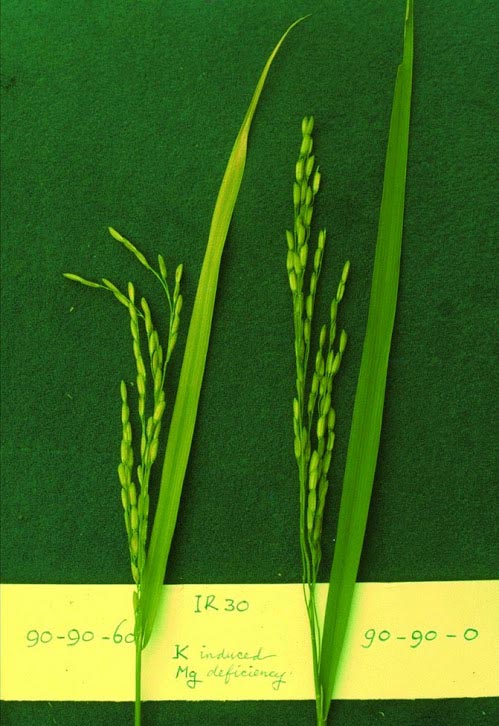
Plants develop orange-yellow interveinal chlorosis in older leaves and later on younger leaves.
Chlorotic leaves with white tips are noticed.
Plants exhibits more number of leaves, reduced number of spikelets and poor grain quality.
Green & yellow coloured bands runs parallel to leaf & also develop wavy and droopy leaves.
In severe cases, leaves may develop necrotic symptoms and entire plant may collapse.
Management
Do the soil analysis and confirm the deficiency.
Addition of Magnesium sulphate (32 kg/ acre) in bands near plants.
Long-term usage of dolomite will reduce magnesium deficiency
Magnesium and potassium fertilizers should not be applied together.
Sulphur(S)
Symptoms
Sulphur deficiency seen on younger leaves
Leaves look pale yellow in colour with stunted growth.
Deficiency leads to reduced number of tillers , spikelets & panicles
Young leaves with chlorotic tips are noticed
Brown spots appear on upper leaves
But necrotic symptoms are not seen on older leaves
Development and maturity of plant is delayed by one or two weeks
Management
Application of sulphur-containing fertilisers, such as Factamfos, Ammonium sulphate, Single superphosphate, etc., reduces the deficiency.
In sulphur deficient soils, apply sulphur dust (10 kilogrammes per acre).
Deficiency in alkaline soil can be reduced by application of gypsum
Addition of organic material improves sulphur availability in the soil.
Burning of organic waste leads to sulphur deficiency
Boron (B)
Symptoms
Symptoms will be first noticed in younger leaves as the element is immobile in nature.
Newly emerging leaves tips are white and rolled.
In severe deficiency death of growing points are noticed, but plant continue to produce new tillers with reduced height
Deficiency leads to poor production of panicles affecting pollen viability & formation of poor chaffy grains.
Management
Analysis of soil to confirm the deficiency.
Application of borax (4 kg/ acre) into the soil
Addition of borax (1 gram / litre of water) as foliar spray.
Avoid the combined application of Boron and calcium.
Application of borax with ammonium fertilizers should be avoided
Copper (Cu)
Symptoms
Deficiency exhibits yellowing of younger leaves
Rolling of new leaves and have a needle like appearance are noticed.
Chlorotic streaks are observed on either side of the midribs of the leaves
Dark brown necrotic lesions on leaf tips
Reduced tillering, delayed panicle emergence & sterility in spikelet
Flowering phase get extended leads to development of smaller grains.
In extreme conditions bluish green colour noticed on leaves.
Management
Application of Copper sulphate (800 gram/ acre) in the soil.
Iron (Fe)
Symptoms
Leaves become yellowish in colour with veins remain green results in characteristic interveinal chlorosis
Plants smaller leaves and at later stages, entire plant become chlorotic & die
Production of reduced grains with poor grain quality
Dry matter production is decreased severely
Management
Iron content in Kerala soils is often high. So, get a soil test to determine the reason for the problem
Low potassium levels lead to iron deficiency
Addition of Ferrous Sulphate (6 kg/ acre) into the deficient soils.
Manganese (Mn)
Symptoms
Symptoms first noticed on leaves just reaching its full size
Pale greyish green interveinal chlorosis spreads from the tip to the leaf base
Newly emerging leaves are short, narrow and light green in colour
Plants develop few leaves, smaller root system, stunted in growth
Necrotic brown spots develop later and leaf becomes dark brown in colour
Management
In Kerala, soils are rich in manganese content. high iron levels may result in magnesium shortage.
Application of Manganese Sulphate (5 gram per litre of water) as foliar spray on soils
Zinc (Zn)
Symptoms
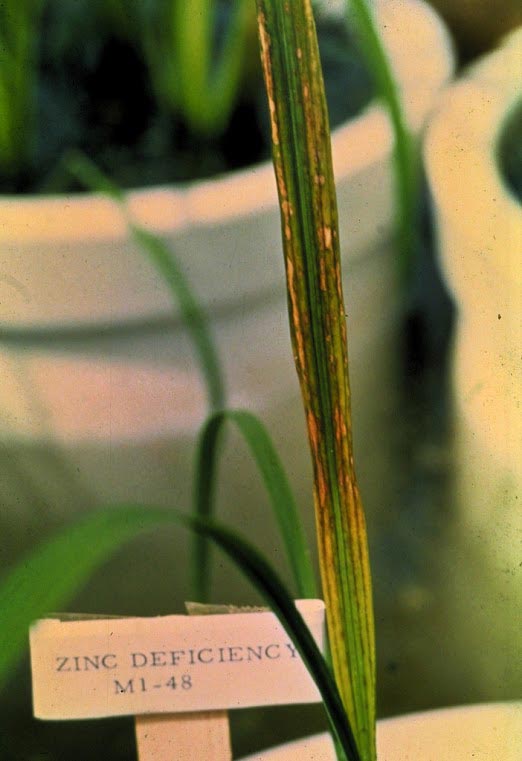
Leaf base of younger leaves become chlorotic brown and blotches/streaks appear on lower leaves.
Reduced leaf blade size
Delayed maturation of plants leads to prolonged vegetative phase results in delayed flowering & grain development.
Dusty brown spots appear on upper leaves, along with white lines appear along midrib
Plants exhibit reduced tillering, poor root development leads to stunted growth
Management
The optimal pH range for zinc availability is 5 to 7.5.
Confirm deficiencies by doing soil testing.
Apply zinc sulphate to deficient soils (8 kg/ acre) at flushing, flowering and fruiting stages.
Avoid the application of Zinc and phosphate fertilisers at the same time
In extreme situations, spray calcium carbonate (2.5 gram/litre of water) with zinc sulphate (2 gram/ litre of water) can be advised