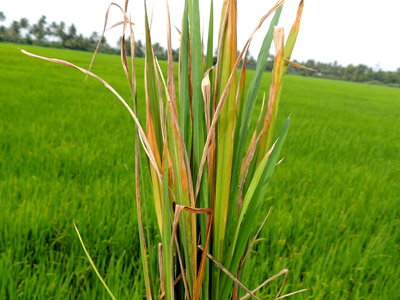
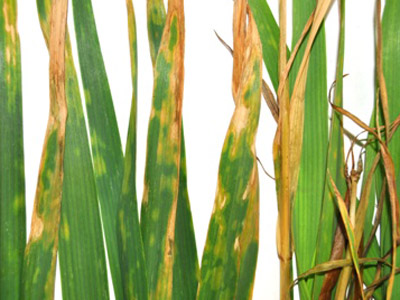
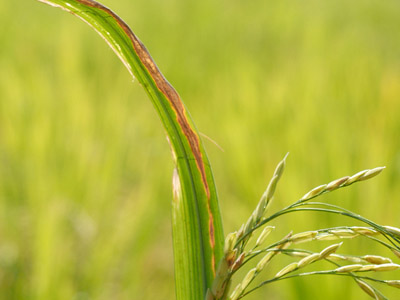
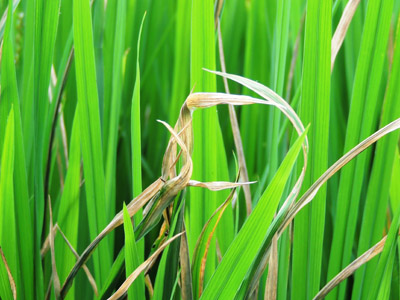
Bacterial leaf blight is charcterized by two phases of infection namely: Kreske and Leaf Blight.
The disease is noticed both in the seedling and in mature plant.
One to two weeks after transplanting, the seedlings show systemic infection known as Kresek. It is the drying or wilting of the whole plant.
Infected leaves and sheath starting from the older ones at the periphery become water soaked and grayish green and fold up and roll along the midrib. These leaves wither and float in water.
Thereafter, the bacterium is carried through xylem vessels and becomes systemic and the entire plant wilts.
This symptom is often confused with damage caused by stem borer injury (dead heart) but the latter can be easily pulled out while it is not so with Kreske affected tillers.
Blightning and yellowing usually appear in July-August.
Infection is most common from the flag stage onwards.
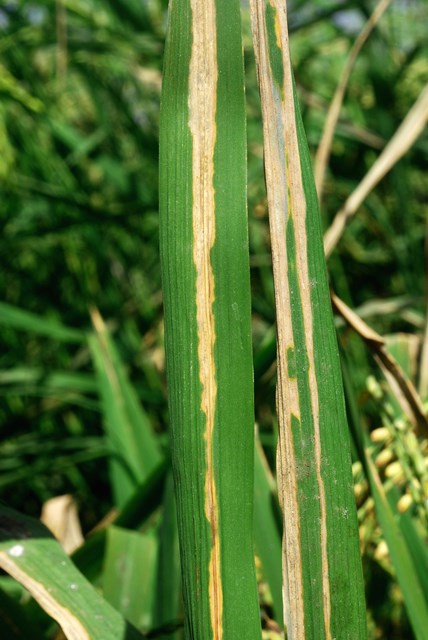
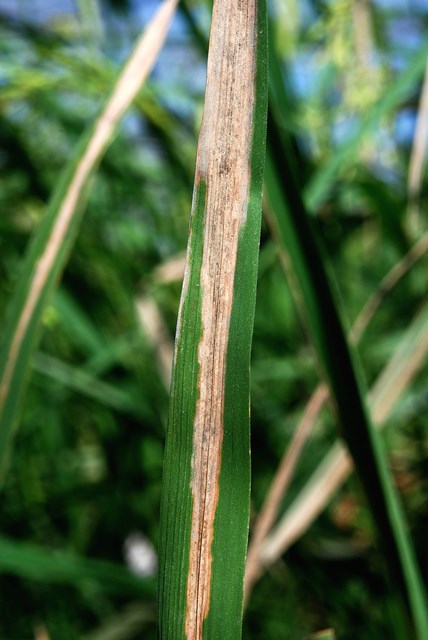
Leaf blight symptom appear as yellow to white water soaked stripes at the margins on the mature leaf blades, which enlarge in length and width and produce the characteristic yellow lesions with wavy margin.
The disease is transmitted through seeds and water.
Rain, light winds, and low temperatures (22 degrees to 26 degrees Celsius) are favorable factors for the development of the disease. The bacteria enter the plants through the pores in the leaves and through wounds on the leaves and roots.
Cutting the tip of the leaves when transplanting and hitting the stem to remove soil can lead to disease.
The regions adjacent to the lesion show water soaking. Later, as a result of growth of saprophytic fungi the dead portion of the lesion turns dark or grayish.
On susceptible varieties, the sheaths are also affected.
On resistant varieties, yellow stripes may be formed which after several days turns brown and necrotic.
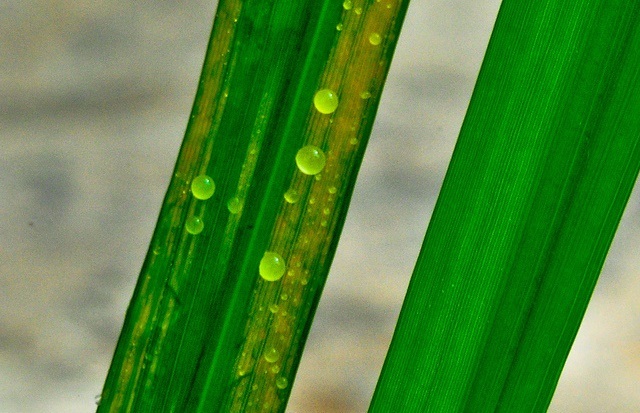
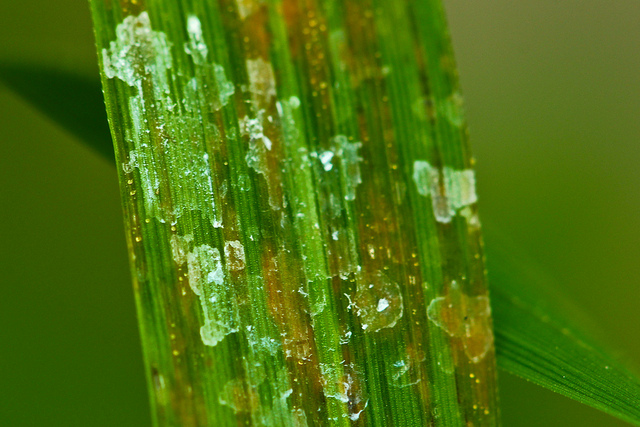
Milky or opaque dewdrops may be noticed on the surface of young lesion in the early morning. These dry up to form small, yellowish, spherical beads, which get detached easily and fall down into the field.
The grains may also show infection, which become discoloured and get surrounded by water soaked margin.
The bacterial blight disease can be confirmed by ooze test. Cut the affected plants at the base and dip it in a glass of water and hold it against the light for few minutes without shaking. White milky bacterial ooze will come out as streams from the cut ends.
The bacterial blight disease can be confirmed by ooze test. Cut the affected plants at the base and dip it in a glass of water and hold it against the light for few minutes without shaking. White milky bacterial ooze will come out as streams from the cut ends.
Management
Use disease free seeds.
Treat seeds in Agrimycin or Streptocycline 100-250 ppm (2.5 gram / 10 litre of water for 10 kg of seed) for 12 hours followed by hot water treatment at 52 degree Celsius for 30 minute.
Seed treatment with Pseudomonas fluorescens (20 g/litre of water for 1 kg of seed), seedling dipping in and prophylatic spraying of Pseudomonas fluorescens (20 g/litre of water) is effective in preventing the incidence of the disease.
Remove and destroy weed hosts.
Avoid clipping the tip of seedling during transplanting.
Go for optimum spacing.
Avoid overuse of nitrogenous fertilizers.
Spray fresh cowdung extract (20 gram fresh cowdung) in one litre of water and allow to settle. Use the supernatant liquid for spraying).
Apply bleaching powder @ 20 bags of 100 gram each for one acre in the irrigation water for checking the spread of the disease.
Spray antibiotics viz. Streptocycline - (15 gram/ 300 litre of water/ha) or Streptomycin sulphate + Tetracycline hydrochloride (Agrimycin 100 or Plantomycin (750 gram/ 500 litre of water/ ha) in severe cases.