

Rice (Oryza sativa)
Sheath rot( Sarocladium oryzae )
Symptoms
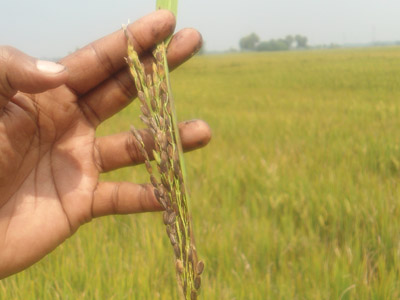
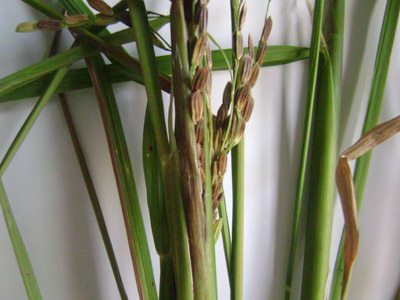
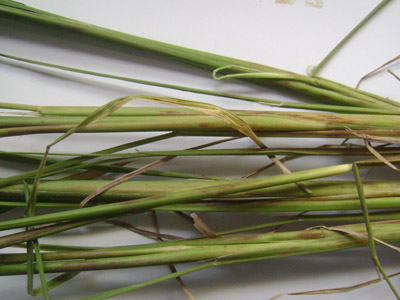
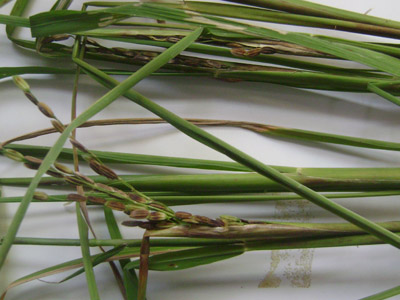
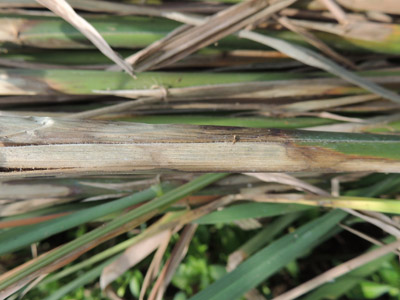
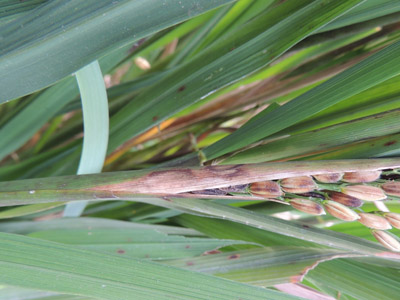
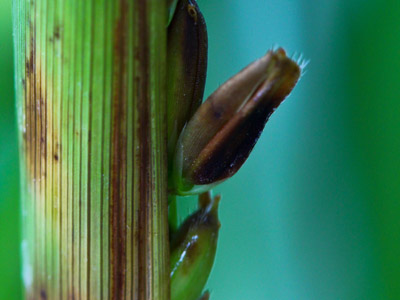
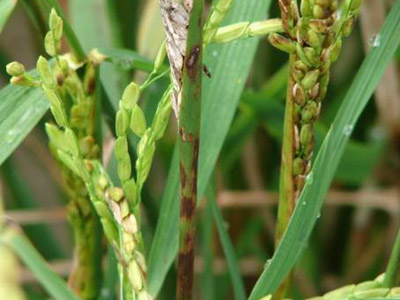
- The disease appears at the time of earing.
- This disease is more common in cases of late planting in the first crop.
- Sheath rot affects the upper leaf sheaths, which encloses young panicles.
- The lesions are oblong to irregular in shape, and are 0.5-1.5 cm long.
- The lesions may have brown margins and grey centre or uniformly grayish brown.
- Gradually lesions enlarge and cover entire sheath.
- Whitish mycelium can be seen in the centre of the lesions on the inner side of the affected sheath.
- The developing panicles are choked within the rotten sheath. Sometimes partial emergence is also noticed.
- The resulting grains will be chaffy or poorly filled, shriveled and discoloured.
Management
- Destroy crop residues immediately after harvest to reduce inoculum level.
- Manage pests such as stem borer and nematodes.
- Apply 50% more potash than recommended dosage in split application.
- Ensure good weed control.
- Use certified and disease free healthy seeds.
- Hot water treatment of seed at 52oC for 8-10 minutes.
- Ensure balanced application of NPK fertilizers.
- Use of resistant varieties such as Aruna, Athira, Asha, Resmi, Nila, Remya, Rajani, and Arathy.
- Follow optimum plant spacing.
- Application of Gypsum is found to reduce disease incidence.
- Seed treatment with Pseudomonas fluorescens (10 g/litre of water for 1 kg of seed)
- prophylatic spraying of Pseudomonas fluorescens (20 g/litre of water) is effective in preventing the incidence of the disease.
- Apply neem cake coated urea.
- Soak seed for 12 to 16 hours in Carbendazim 50 WP (2 gram / kg of seed per litre of water).
Chemical Control
| Sl.No | Generic Name | Trade Name | Color code | Dosage/litre | Knapsack Sprayer (Capacity 10L) | Dosage/acre (200 L) | Dosage/hectare (500 L) | Remarks |
|---|---|---|---|---|---|---|---|---|
| 1 | Mancozeb 75 WP | Devidayal M-45, Dhanuka M 45, Dhanuka M-45, Dithane, Dithane M-45, Hilthane, Hindustan M 45, Indofil M 45, Izeb M-45 Manzate, Luzen-45, Macoban, Macoban M-45, Mancosaan, Mancosaan M-45, Maneb Manzane, M-Guard, Savour M 45, Tata M-45 Eurofil-NT, Uthane M-45, Veera, Zinthane; | Green | 3 g/ litre of water | 30 g | 0.6 kg | 1.5 kg | |
| 2 | Carbendazim 50 WP | Bavistin, Benfil, Bengard, Benlate, Benmain, Bensaan, Carben, Carziim50, Dhanustin, Dhanustin 50 WP, Fungiguard, Gancarzin50, Glizim, Mintho, Tagstin, Tiara, Zoom | Green | 1 g/ litre of water | 10 g | 200 g | 500 g | 3 | Hexaconazole 5 EC | Alert Creeper, Contaf, Corazole, Danzole, Force 5C, Hexaan, Hexacone, Hexadhan, Hexamax, Hexan, Hexazole, Mainex EC, Sitara, Strike, Titan, Topper, Topper plus EC, Xantho | Blue | 1 ml/ litre of water | 10 ml | 200 ml | 500 ml |
Extremely Toxic

Highly Toxic

Moderately Toxic